Where to Sell Ebooks: 10 Platforms Compared
Where to sell ebooks? Compare 10 platforms for royalties, fees, storefronts, delivery, reach, and direct sales control.

For most authors, the practical starting point is Amazon Kindle Direct Publishing, where eligible ebooks can earn a 35% or 70% royalty. Choose a marketplace when discovery matters, a direct storefront when owning the customer relationship matters, and an integrated platform when you want to create, sell, deliver, and follow up in one place.
The popular advice to “pick the biggest platform” misses the key decision. A marketplace can put your book in front of shoppers, but it doesn't give you the same control over the buyer relationship as selling directly. A distributor can simplify retail expansion, while an integrated platform can connect product creation with checkout and follow-up. Each model solves a different problem, and the right mix depends on how readers will find your ebook and what you want to sell them next.
The ebook market is substantial and has continued to grow, but published estimates use different methodologies and shouldn't be combined as a single audited series. One estimate places global ebook revenue at approximately $14.6 billion in 2022, while another values the worldwide market at about $22.45 billion in 2024 and projects growth beyond $36.57 billion by 2034. Those estimates reinforce a practical point: channel choice is a business decision, not a final upload step. (Global ebook market estimates)
1. Genesize
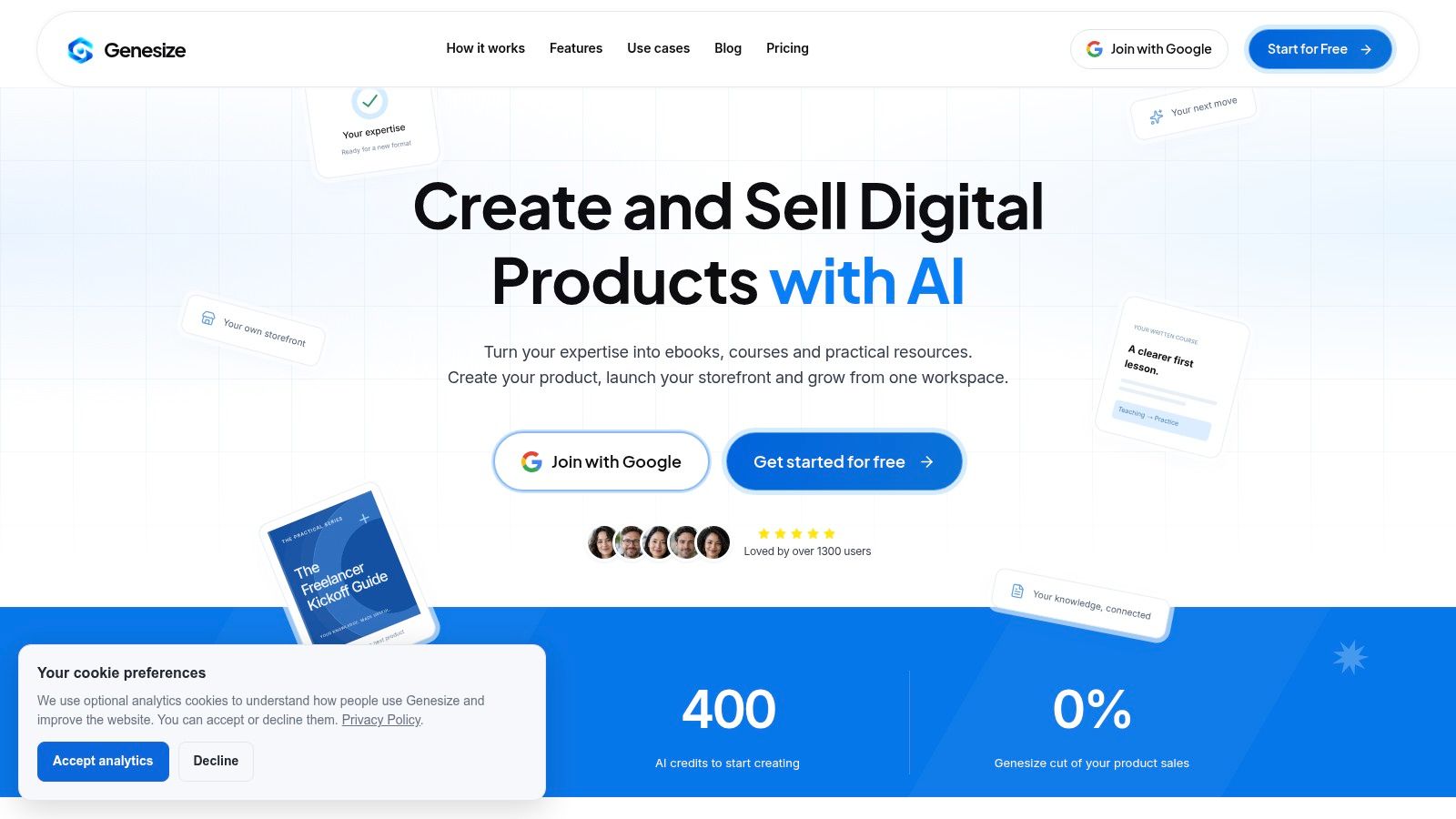
Genesize fits creators who want to build an ebook business around their expertise rather than upload a finished file to a bookstore. Its connected workflow turns notes, examples, and writing samples into an AI-assisted draft, which you can edit and shape before exporting as a PDF or Word document. It can also help draft a sales page and connect the product to a hosted storefront.
Best when the ebook is part of a business
Genesize brings product drafting, storefront, Stripe checkout, file delivery, and customer tools into one workspace. That suits a consultant selling a workbook alongside services, an educator building a practical guide, or a small business using an ebook to introduce a broader offer. On eligible plans, CRM records, email campaigns, automated follow-ups, sales analytics, and Growth Agent recommendations help manage the relationship after a purchase.
The trade-off is that this model depends on your own audience and promotion. A hosted storefront does not put your book in front of marketplace shoppers. Email sending requires an eligible paid plan and sender setup, and AI-assisted creation is subject to credit limits. Communities and paid memberships are planned, not currently available. The Creator plan is listed at $58/month after the trial, with Stripe processing fees on top, so factor that into your pricing before committing.
The upside is consolidation. Drafting, sales pages, checkout, delivery, and follow-up live in one place, and you can still export the finished file and distribute it through retailers if you want wider reach later.
Practical rule: Use Genesize when the ebook is a product you'll keep developing, promote, and connect to other offers. Use a retailer when bookstore discovery is the priority.
2. Amazon Kindle Direct Publishing (KDP)
KDP is the clearest starting point for authors whose readers shop for ebooks on Amazon. You can publish Kindle ebooks, set prices and territories, and use Amazon's retail marketplace without paying an upfront publishing fee. It's a marketplace channel, not a customer-owned storefront, so prioritize it for reach rather than expecting it to manage your broader audience.
Price for the royalty you actually qualify for
Amazon offers eligible ebooks either a 35% or 70% royalty option. The 70% option has territory and pricing rules, and Amazon deducts delivery costs from the royalty. Its KDP help page reports a U.S. price band expansion from $2.99–$9.99 to $2.99–$12.99, so check the current requirements before setting your list price. (Amazon KDP royalty and pricing terms)
That delivery deduction matters for image-heavy workbooks and illustrated guides. A smaller, well-optimized ebook file can help protect the net royalty, but don't remove useful images just to chase a headline rate. For an additional perspective on selecting a publishing workflow, see this guide to the best digital product tools.
KDP Select can offer promotional options, but enrolling requires digital exclusivity during the enrollment period. If you want to sell the same ebook directly or through other retailers, check those terms before opting in. KDP is a strong discovery channel; pair it with another sales model if you want greater control over customer follow-up. Visit Amazon Kindle Direct Publishing.
3. Apple Books for Authors
Add Apple Books when your readers already live on iPhones and iPads. It is a marketplace channel: Apple runs the storefront, discovery, and checkout, and you get a listing, sales reports, and promotional links through its publishing portal. The portal also walks you through file upload, territory selection, and per-market pricing. Treat it as one retail destination in a wider mix, not as your home base.
The royalty math is the draw. Apple pays a flat 70% on ebook sales at every price point, and it does not deduct a delivery fee, so illustrated workbooks and image-heavy guides keep more of each sale than they would on a retailer that charges for file size. (Apple Books publisher terms)
That rate buys you shelf space, not demand. Apple Books does not hand you customer emails, a branded storefront, or a way to bundle bonus downloads and run your own follow-up. If audience ownership is the goal, a direct sales tool does that job; Apple Books exists to put your title in front of readers who shop inside Apple's ecosystem. Check its publisher requirements and payout terms before uploading, and weigh the net royalty against the stores where your audience already buys.
My recommendation: list here for the flat royalty and the device-loyal readership, then pair it with a channel where you own the customer relationship. Start with Apple Books for Authors.
4. Kobo Writing Life
Depending on Amazon for every retail sale is a fragile setup. Kobo Writing Life is the most practical counterweight: one upload lists your ebook on Kobo's store, and its retail partnerships carry the title further without extra uploads. The self-service portal handles territory selection, promotions, and sales reporting.
The royalty structure rewards standard pricing. Kobo pays 70% at or above roughly $2.99 and 45% below that line, so a $0.99 novella earns a thinner share here than a full-priced title. (Kobo Writing Life royalty terms)
Price accordingly.
Where does Kobo fit in a sales mix? Its readership tends to be strongest outside the U.S., in markets like Canada and the UK, which makes it a useful complement to Amazon-heavy distribution. That reach costs you another account, listing, and promo calendar to manage. Keep your cover, description, and metadata consistent across stores, but shape promotions to Kobo's audience. The program is non-exclusive, so listing here never locks you out of other channels.
My recommendation: once your ebook is priced above the 45% cutoff, add Kobo. It won't give you customer emails or a branded storefront, so pair it with a direct sales channel if owning the buyer relationship matters.
5. Google Play Books
Google Play Books fits the broad-distribution sales model: one upload puts your ebook in Google's store, priced per country, sold to readers who buy through Android devices and the web. Add it when you want wider retail coverage. Don't add it expecting the store to market the book for you.
The economics are stronger than most retail listings. Partners who accept the current terms earn a 70% revenue split in more than 60 countries, and Google applies that rate without a minimum price, so a cheap launch title keeps the same share as a full-priced one (Google Play Books revenue split terms). There's no platform fee or payment-processing charge stacked on top. The split is the whole cost of the channel.
Country-level pricing and promotional codes give you control over launches in specific markets, and the sales reports show which territories respond. That's real leverage if you sell internationally.
Know what you're giving up, though. Google keeps the buyer relationship: you get revenue reports, not customer emails, and there's no storefront to brand. If owning that relationship matters, run a direct sales channel in parallel and treat Play Books as incremental reach.
My recommendation: list here once your book is priced and stable elsewhere, then use per-country pricing to test new markets instead of discounting globally. Get started through Google Play Books Partner Center.
6. Barnes & Noble Press
Barnes & Noble Press lets authors publish ebooks for sale to the NOOK readership. It can complement a wider retail plan if you want to add a recognizable bookseller without moving your entire sales operation. The service also offers print-publishing options, which may appeal to authors considering both digital and physical editions.
The company advertises a flat 70% ebook royalty, but confirm current terms and eligibility before relying on that figure in your pricing decisions. The audience is tied to Barnes & Noble and NOOK, so this is a retailer listing, not a branded direct-sales storefront. You'll still need to generate attention and maintain your listing alongside any other retailer accounts.
A practical approach is to add Barnes & Noble Press when you already have a wider publishing plan and can keep the extra account up to date. Don't expect the retailer alone to produce sales; promote the title through the same channels you use for your other listings.
If you're comparing direct publishing with broader online selling approaches, this guide to selling ebooks online can help frame the channel decision. Check the latest royalty calculator and publisher terms at Barnes & Noble Press.
7. Draft2Digital
Draft2Digital is for authors who want broad retail distribution without setting up and managing every participating retailer account themselves. You publish through one distributor account, then use its dashboard to manage distribution and review sales reports. Its conversion and formatting tools can also simplify preparation for multiple outlets.
Trade some control for simpler distribution
The convenience has a cost: Draft2Digital takes a share of sales. New accounts may also face a one-time activation fee, and an annual maintenance fee may apply under stated conditions for accounts with low earnings. Check the current fee terms before signing up, and compare the total cost with the time you'd spend managing each retailer directly.
The distributor model also means less direct control than publishing to each store yourself. That can be a sensible trade if convenience matters more than adjusting every retailer listing independently. Draft2Digital doesn't claim ownership of your book copyright, but you should still review its distribution terms and ensure the stores you want are available through the service.
A distributor saves account-management work. It doesn't take the place of your promotion plan or turn retail listings into owned customer relationships.
Use Draft2Digital when broad distribution and simpler administration are your priorities. Publish directly to a retailer when you need closer control over that store's settings and promotions. Visit Draft2Digital.
8. Gumroad
Gumroad is a direct-selling option for creators who want to upload an ebook, create a product page, and share a checkout link without building a full ecommerce site. It also supports other digital products, making it a reasonable starting point for an author who plans to sell related downloads alongside a book.
The key trade-off is fees. Direct sales carry a percentage fee and a fixed fee, and payment-processing costs apply separately. That fixed component can weigh more heavily on a low-priced ebook, so calculate what you'll keep after the applicable charges rather than judging the platform by its lack of a monthly subscription. Marketplace discovery sales carry a higher fee, which makes them a different sales model from a purchase driven by your own email list.
Gumroad can handle a straightforward direct checkout, but it doesn't remove the need to bring people to your page. Promote the link through your audience channels and consider whether your product needs more structured buyer follow-up or a branded store experience. For a plain-language explanation of downloadable products, see what a digital download is.
Choose Gumroad for simple setup and direct links, not as a substitute for building an audience. Review the current fee schedule at Gumroad before setting your price.
9. Payhip
Payhip suits creators who want to own the customer relationship from day one. It gives you a hosted storefront with a product page and checkout for ebooks, and it can also bundle related downloads, courses, or memberships under the same roof. That makes it a sensible base for a small product line rather than a single title.
Do the pricing math before you publish. The free plan carries a 5% Payhip transaction fee, and payment-processing costs come on top of that, so your real margin is thinner than the headline figure suggests (Payhip pricing and plan terms). A low-priced ebook set without both costs in mind can end up earning less than you expected.
There is no browsing audience waiting for you here. Sales arrive because you send them, through an email list, social accounts, content, or partnerships. Accept that trade when customer ownership and bundling matter more to you than built-in discovery.
Choose Payhip for a hosted direct-sales storefront that can grow into a broader digital catalog. Price your book with platform and processing fees combined, plan follow-up for repeat buyers, and check current terms at Payhip's digital-product storefront.
10. Etsy
Etsy is a consumer marketplace where sellers can list eligible digital downloads, including ebooks and guides. It fits products that shoppers can understand quickly from a visual listing, such as planners, workbooks, and niche instructional PDFs. Etsy search and browsing may help shoppers encounter a product, but visibility is not predictable enough to replace your own promotion.
Make the listing fit the product
Etsy handles digital delivery, so sellers don't need to ship a physical file. But listing and transaction fees apply, and advertising can add costs. Treat those as separate from any payment-processing charges, and check Etsy's current seller terms rather than assuming that marketplace access is cost-free.
The format also affects who you reach. A polished planner or workbook can be presented visually in listing images, while a long-form ebook may be harder to explain in a marketplace thumbnail. Build a clear product description that tells buyers what they'll receive, how they can use it, and what the download includes.
Etsy's standards matter: listings must meet the platform's rules for seller-designed or otherwise eligible items. Competition can also make marketplace visibility difficult to predict, so don't build your whole business around the hope that search will deliver customers.
Choose Etsy when the ebook is a visually presented, niche digital product that fits how shoppers browse the marketplace. Review seller requirements and fees at Etsy's seller information page.
Top 10 Ebook Selling Platforms Compared
| Platform | Core features | Audience & reach | Fees & value | Best fit / standout |
|---|---|---|---|---|
| 🏆 Genesize | AI-assisted ebook/course creation, storefront, Stripe checkout, delivery, CRM and email tools | 👥 Creators selling to their own audience | 💰 Creator plan listed at $58/month after trial; 0% Genesize sales commission; Stripe fees apply | ✨ All-in-one workflow using your notes and writing style; ★★★★★ for integrated creation and selling |
| Amazon Kindle Direct Publishing (KDP) | Kindle ebook publishing, pricing controls, reports and optional promotions | 👥 Authors targeting Kindle shoppers | 💰 Free to publish; royalties vary by option, price and territory | ✨ Amazon marketplace access; ★★★★★ for reaching Kindle readers |
| Apple Books for Authors | Ebook publishing, sales reports and promotional links | 👥 Authors reaching Apple Books customers | 💰 Apple states 70% royalties at all price points | ✨ 70% rate without a price-band condition; ★★★★☆ for Apple ecosystem reach |
| Kobo Writing Life | Ebook publishing, territory controls, promotions and sales dashboard | 👥 Authors seeking international readers | 💰 Free to join; 70% royalty has price conditions | ✨ Kobo store and retail partners in 190+ countries; ★★★★☆ for broad reach |
| Google Play Books | Ebook uploads, country pricing, promo codes and reports | 👥 Authors targeting Google Play readers | 💰 70% revenue split in eligible countries under updated terms | ✨ Country-specific availability; ★★★★☆ for additional international distribution |
| Barnes & Noble Press | Ebook publishing, NOOK listings, royalty calculator and print options | 👥 Authors seeking Barnes & Noble customers | 💰 Ebook service described as free; advertises 70% ebook royalty | ✨ Adds a major U.S. bookseller channel; ★★★☆☆ for retailer-specific reach |
| Draft2Digital | Multi-retailer distribution, formatting tools and centralized reporting | 👥 Authors wanting distribution through one account | 💰 Takes a share of sales; activation or annual fees may apply | ✨ Simplifies multi-store publishing; ★★★★☆ for distribution convenience |
| Gumroad | Hosted product pages, checkout links and digital delivery | 👥 Creators with an audience or seeking marketplace discovery | 💰 No monthly subscription; transaction and processing fees apply | ✨ Quick setup for ebooks and other downloads; ★★★★☆ for direct sales |
| Payhip | Storefront, checkout, digital downloads, courses and memberships | 👥 Creators selling directly to their audience | 💰 Free plan charges a 5% transaction fee; processing fees separate | ✨ Supports bundles and multiple product types; ★★★★☆ for low-commitment starts |
| Etsy | Digital listings, marketplace search and automatic delivery | 👥 Sellers of niche or visually presented guides and resources | 💰 Listing and transaction fees; advertising charges may apply | ✨ Marketplace discovery for eligible downloads; ★★★☆☆ for niche products |
Build a Sales Stack That Fits Your Book
Pick each channel for the job it does. Marketplace discovery starts with Amazon KDP, then extends to Apple Books, Kobo Writing Life, Google Play Books, or Barnes & Noble Press when their audiences and terms suit your book. If maintaining separate retailer accounts becomes a burden, a distributor such as Draft2Digital consolidates the work, and its share of sales is worth weighing against the hours it saves you.
For audience ownership, sell through a hosted direct storefront such as Genesize, Gumroad, or Payhip. That route puts promotion on you and means understanding costs beyond a headline platform fee. Genesize connects creation, a storefront, Stripe checkout, delivery, and customer follow-up tools. Gumroad emphasizes quick product-page setup. Payhip supports direct sales alongside other digital offers. Choose based on the workflow you need, not a feature checklist.
Run the numbers per channel before you set a price. For example, a $9.99 ebook on KDP's 70% royalty option nets roughly $6.99 before delivery costs, while the same price on Gumroad has to clear its percentage fee, fixed fee, and payment processing before you see a comparable amount. A distributor takes its share off the top as well. Work out what remains after fees, taxes, refunds, and whatever you spend to bring buyers to the listing.
That remaining figure, not the sticker price, is what your pricing should rest on.
Versioned products need a different plan from a finished, static book. If you sell a technical manual, teaching resource, or professional workbook that you will update, decide how buyers receive revisions and how you notify them. Direct sales support an ongoing relationship more naturally, while marketplaces remain a separate discovery route. Don't promise ongoing updates unless you're prepared to deliver them.
Start with the channel that matches your immediate goal, then add others only when they serve a clear purpose. Track sales and costs by source, review whether each channel brings profitable customers, and adjust your distribution accordingly. A visible listing is useful, but profit, repeat purchases, and control over the next customer interaction matter more than being everywhere.
If you want to create an ebook from your expertise and connect it to a storefront, checkout, file delivery, and customer follow-up, Genesize brings those steps into one workspace. Start by shaping your material into a product, then choose whether to sell it directly, export it for retailers, or use both routes.