Best Digital Product Tool 2026: Free Ebook Workflow
Find the best digital product tool 2026 for drafting, designing, and selling an ebook. Free workflow with templates, exports, and distribution tips.
You've got the idea for an ebook, a course, or a guide, but the work is still sitting in your head and a few messy notes. You don't need a giant software stack to get it out the door. You need a clean path from raw expertise to a file someone can download, read, and trust.
The best digital product tool 2026 for a first-time creator isn't the one with the longest feature list. It's the one that gets you from blank page to delivered PDF with the fewest moving parts. For a free workflow, that means four jobs done well, drafting, design, export, and distribution.
That's the whole game. If you can assemble those pieces without paying for software, you can test an offer before you start stacking subscriptions. The free path breaks in one place, though, and I'll call that out clearly so you don't build a process you'll outgrow the moment buyers show up.
Starting From Knowledge and a Blank Page
Most first ebooks don't start with a polished outline. They start with a person who knows a lot about one thing and doesn't know how to package it yet. That's normal, and it's exactly why a cost-free workflow still matters in 2026. Global business e-commerce reached about $28 trillion in 2024 across 45 developed and developing economies, which shows how mature the online buying environment has become for digital goods broadly, even though that figure isn't the size of the ebook market itself. UNCTAD's 2024 e-commerce insight
Work with the order that reduces friction
Start with the content, not the cover. If you have to choose where to spend your energy first, write the manuscript before you touch fonts, mockups, or mock sales pages. Buyers don't care how pretty a half-finished cover is if the ebook doesn't solve their problem.
A simple free workflow keeps the pressure down:
- Draft first, using a word processor or plain text editor.
- Design second, once the chapters and sections are stable.
- Export third, with a clean PDF as the main file.
- Distribute last, through email, a download page, or a storefront.
That order matters because each step depends on the one before it. If you design too early, you'll keep changing the layout. If you export too early, you'll keep re-exporting. If you set up delivery too early, you'll end up rebuilding links every time the file changes.
Practical rule: don't buy software to solve a problem you haven't had yet. Make the free workflow prove the offer first.
This article is for the person who wants the shortest path to a sellable ebook, not a sprawling product system. If you eventually want a hosted storefront, checkout, email follow-up, and analytics in one place, that's where an integrated workspace starts to make sense. For now, free tools are enough to get the first version live.
Free Tools Versus an Integrated Workspace
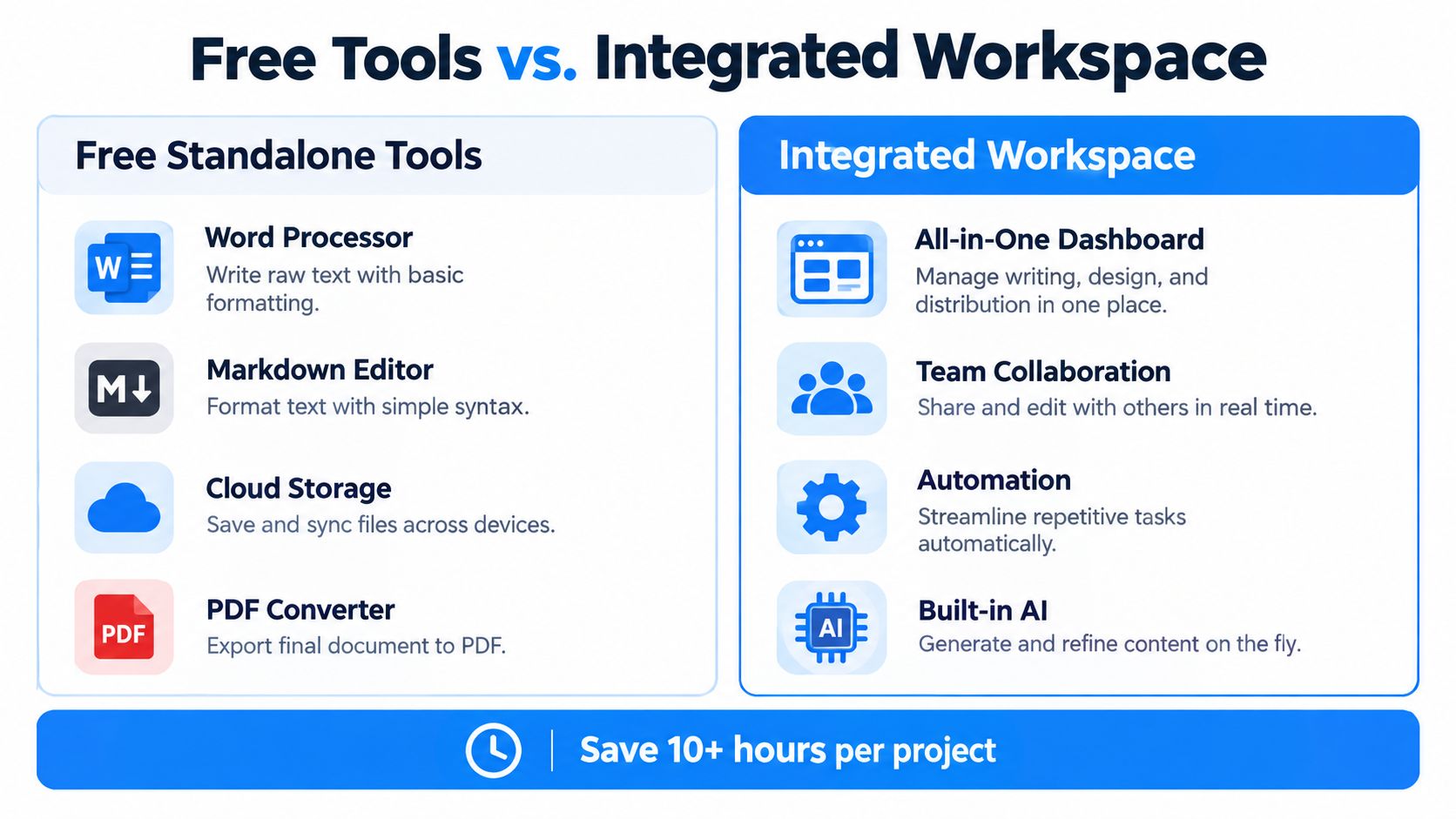
The choice isn't "free" versus "paid." It's whether you want to stitch together separate tools or work in one integrated workspace. Free tools are great when you want ownership and flexibility with almost no learning curve. They're weaker when every handoff, writing, design, checkout, delivery, and follow-up, becomes a place where you can lose time or break the flow.
The catch is that online buying isn't evenly distributed. UNCTAD data from the World Bank Global Findex reported that 39.0% of people aged 15 and older worldwide bought something online in 2021, with much higher use in developed economies and far lower use in least-developed countries UNCTAD's online purchasing overview. That's a reminder that a creator-facing workflow has to stay simple, mobile-friendly, and easy to recover when access is shaky or checkout is confusing.
What free tools do well
Free standalone tools win on control. You can write in Google Docs, keep notes in a markdown editor, design in a separate layout app, and export whenever you want. That keeps your ownership clean and your budget intact.
They're also easier to replace. If one tool annoys you, you swap it out. If you want to hand the files to a collaborator, a reseller, or a designer, you can. That portability matters because any product workflow can get messy once you start selling.
Where an integrated workspace helps
An integrated workspace reduces the friction between the steps that usually break. Instead of moving from a doc to a design tool to a checkout system to delivery emails, you stay inside one environment. That's useful when you're moving fast, especially on a first paid product where setup fatigue is real.
A platform like this all-in-one comparison is worth looking at when you care more about launch speed than tool-hopping. The trade-off is dependency, because more of the workflow lives with one vendor.
Use free tools when you're still proving the offer. Use an integrated workspace when the product is ready to sell repeatedly and you want fewer moving parts.
Drafting the Ebook With Free Editors and AI
Drafting is where most first-timers waste time by trying to sound like a “real author” instead of sounding useful. Don't do that. Write the ebook like you'd explain the process to a client or a colleague, then clean it up into chapters.
Start with your own material, not a blank prompt
A free word processor is enough for the first pass. Google Docs works because it's easy, collaborative, and forgiving. A markdown editor is useful if you like clean structure and plain text. Use whichever one lets you type without friction.
The better move is to run an AI interview on your own expertise instead of asking for generic chapters. Recent Adobe research across more than 16,000 creators found that 93% say creative AI helps them produce content faster, while 75% describe it as integrated or essential to their work and 87% say it has accelerated business or audience growth Adobe's creator research. That doesn't make AI the product. It makes it a draft assistant. The product is still your method.
Use a prompt like this:
“Interview me for an ebook about [topic]. Ask one question at a time. Pull out my process, examples, mistakes, client stories, and frameworks. Do not invent facts. Turn my answers into chapter ideas, then summarize each chapter in plain English.”
Turn the interview into chapters
Once the interview is done, sort the answers into a simple structure. For a first ebook, I'd use this pattern:
- What the reader is struggling with
- What to do first
- Common mistakes
- Your method
- Templates, examples, or checklist
- How to apply it
That structure is boring in the best way. It reads clearly, and it's easy to expand later. For example, if you're building a 30-page ebook on client onboarding, you can pull chapter material from one 20-minute interview and expand each answer into a section with a takeaway and a mini example.
A good rule is to add one personal example to every chapter. If AI draft text doesn't contain anything specific you've done, rewrite it. Generic prose is where trust goes to die.
Designing the Layout and Cover for Free
Design should make the ebook easier to read, not prettier in a vacuum. First-timers usually get this backwards. They spend hours on the cover, then rush the interior, which is the part the buyer has to live inside.
Keep the interior simple and readable
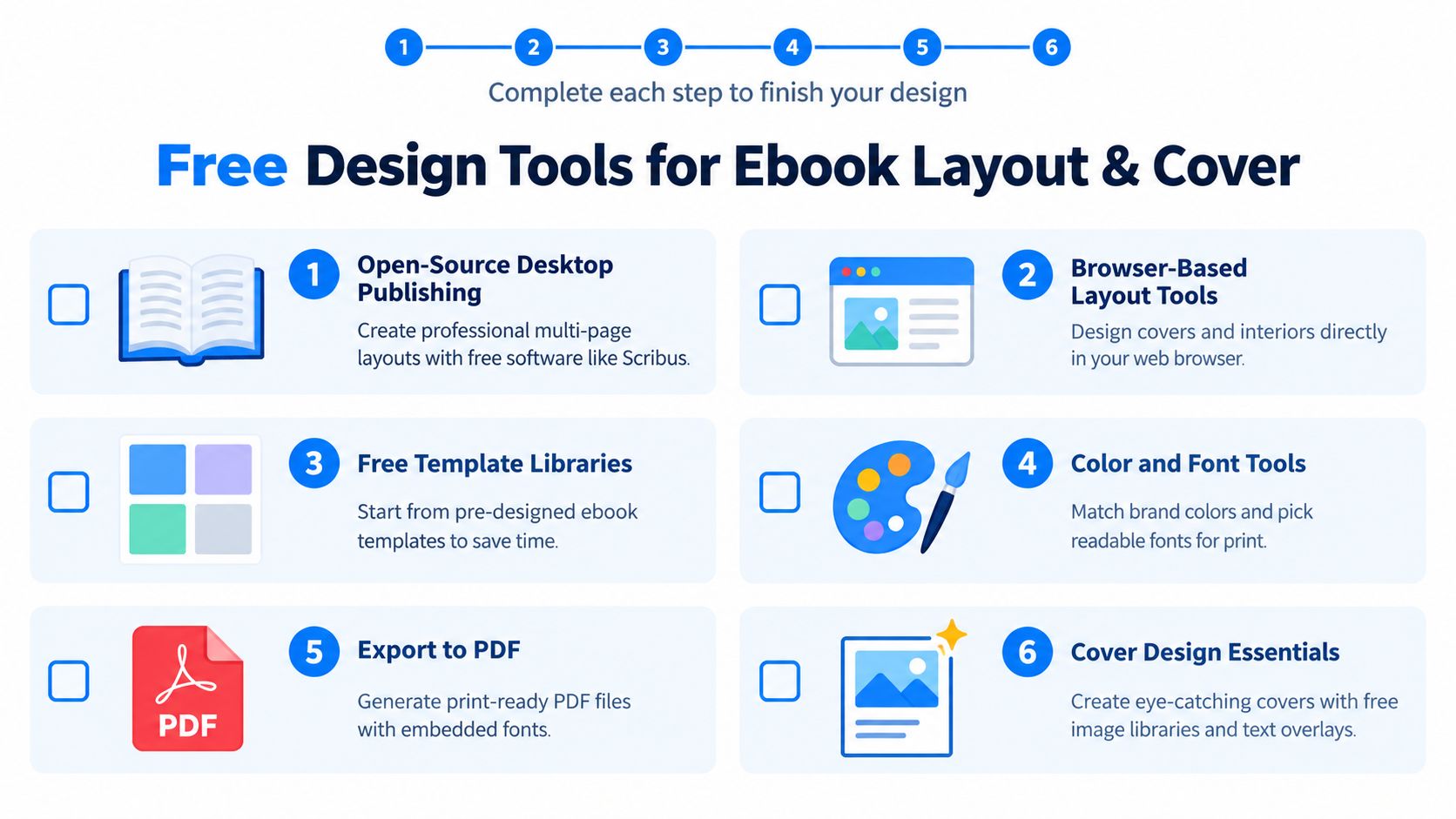
Use a free layout tool that handles multi-page documents cleanly. Open-source desktop publishing software is enough for most ebooks, and browser-based editors with free tiers can also do the job when the layout is simple. Set the trim size, margins, and body font before you place any decorative elements.
A clean chapter template beats clever formatting. Give each chapter the same heading style, the same spacing, and the same hierarchy for callouts or checklists. Readers notice consistency much more than flair.
Make two cover concepts, not ten
A first cover should answer three questions fast, what is this, who is it for, and why should they care now? I'd make two versions, one plain and one slightly bolder, then compare them side by side. If the design gets fancier without getting clearer, drop it.
| Cover comparison checklist | What to check |
|---|---|
| Promise | Does the title tell the reader what result they're getting |
| Clarity | Can someone understand the topic in a second or two |
| Readability at thumbnail size | Can you still read the title when it's small |
| Contrast | Does the text stand out from the background |
| Consistency | Does the cover match the tone of the interior |
The common mistake is treating the cover as branding theater. A solid cover is a sales job, not an art project. If you're stuck, simplify the typography and make the title larger before you add anything else.
Exporting to PDF and Word
Export is where a lot of free workflows fall apart. The file looks fine on your screen, then the fonts shift, spacing breaks, or the buyer gets a clunky download. That's why export settings matter more than most beginners think.
Keep two files, not one
Your main delivery file should be a PDF. If you expect collaborators, resellers, or editors to want to reuse the content, keep a Word export too. PDF is for delivery. Word is for editing, rebranding, and internal handoff.
The details that matter are simple. Make sure fonts are embedded, images are sharp enough for reading, and the file opens cleanly on a phone. If your layout tool offers an accessible or tagged PDF export, use it. If it gives you a web-optimized version, keep that alongside the print-ready one so buyers on slower connections don't struggle.
Name files like you expect to find them later
Use filenames that tell you what version the file is. A clean naming pattern saves headaches when you're updating the ebook after launch.
- Final PDF: for buyer delivery
- Web PDF: for lightweight downloads
- Word draft: for editing and collaboration
- Cover file: for future revisions
That's enough for most first projects. You don't need twenty export versions. You need files you can identify at a glance six months from now without opening them all.
If a file name makes you pause, it's already too vague.
Distributing the Ebook and Handling Delivery
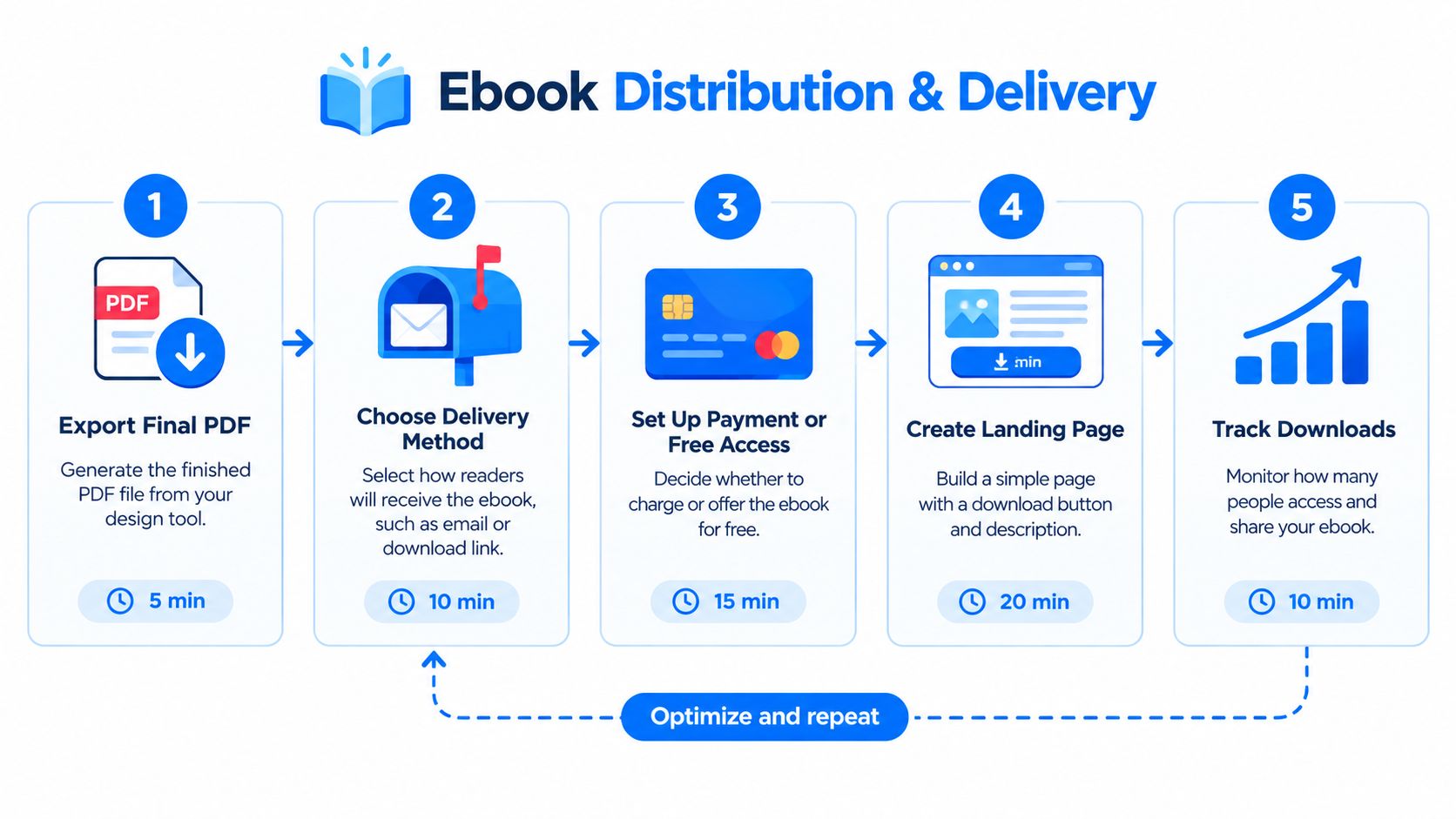
Distribution is where a free workflow stops feeling theoretical. A polished PDF sitting on your desktop only becomes a product when a buyer gets access without friction.
Use the simplest channel that matches the offer
If the ebook is free, a landing page with a download button is enough. If you are testing a paid version, manual email delivery after payment confirmation can work for a tiny launch. Once you are ready to charge consistently, move to a hosted storefront with automatic payment and file delivery, and the Genesize overview shows what that step looks like in practice.
Test the full buyer journey on mobile and desktop, not just the sales page. Baymard's checkout usability research reports a global cart-abandonment average of about 70.19%, and 17% of surveyed U.S. online shoppers said they abandoned an order because checkout was too long or complicated Baymard's checkout usability research. Delivery is part of conversion. If the handoff feels clumsy, buyers leave before they ever read the file.
Run a delivery checklist before you publish
Before you tell anyone the product is live, check these points:
- The file opens on mobile, not just on your laptop.
- The link works after refresh, not only on first click.
- The buyer gets clear instructions, especially if access depends on email.
- A failed payment doesn't break the process, because failed attempts happen.
- The download page is short and obvious, so readers don't have to hunt.
Free delivery works until you start selling repeatedly. Manual handling is the first bottleneck that shows you need automatic access, a proper storefront, and less support work around every order.
Keeping Your Voice and Originality Visible
The biggest mistake with AI-assisted ebooks is not “using AI.” It's letting AI flatten the thing that made the ebook worth buying in the first place. Your examples, your shortcuts, your warning signs, and your point of view are the value. If the draft loses those, it becomes generic content with a cover.
Run a human pass before you export
The fastest review pass is simple. Read the draft once for voice, once for facts, and once for usefulness. On the voice pass, ask whether the reader can tell this came from someone who has done the work. On the facts pass, delete anything you can't stand behind. On the usefulness pass, look for steps that could be sharper, shorter, or more concrete.
That's where your earlier AI interview pays off. Because the draft started from your own notes, examples, and framework, you're not trying to rescue a random AI article. You're editing a structured version of your own material.
Keep a short author note if AI helped
You don't need a long disclaimer. A short note is enough if AI assisted the drafting. Keep it plain and direct, and make sure it doesn't diminish the actual human work.
Author note: This ebook was drafted with AI assistance, then reviewed and edited to reflect my process, examples, and recommendations.
That kind of note does two things. It shows you're not hiding the workflow, and it tells the reader that the final product still reflects your judgment. Transparency helps when you're selling educational material, especially if the ebook makes claims about process or results.
Use the launch checklist that keeps free sane
Here's the version I'd print and use:
- Draft completed in a free editor or word processor.
- Personal examples included in the key chapters.
- Unsupported claims removed from the draft.
- Layout finished with a simple, readable template.
- Cover checked at thumbnail size.
- PDF exported and opened on mobile.
- Word file saved if anyone else may edit the content.
- Delivery tested on mobile and desktop.
- Voice pass completed before release.
Free stops being enough for many creators when they start charging real money. At that point, you usually want a hosted storefront, Stripe checkout, automated delivery, email follow-ups, and basic analytics in one place. An integrated workspace like Genesize is one path for that next step, especially if you want the product, the storefront, and the follow-up flow to live together instead of scattered across tools.
Genesize is built for creators who want to turn an ebook or course into a product with AI-assisted drafting, a hosted storefront, checkout, delivery, and email follow-up in one workspace. If this free workflow helped you see the path more clearly, visit Genesize and compare what stays simple when you're ready to move from a one-off PDF to a real selling system.
Prepared with Outrank