Kajabi vs Genesize: Best All in One Platorm for Digital Products
Kajabi Vs Genesize: Best all in one platorm for digital products. Compare Kajabi and Genesize for creating and selling digital products. Find the best all

What matters more in a digital product platform, a longer feature list or the messy details that decide whether you keep more revenue, stay out of inbox trouble, and own your content when AI gets involved? That's Kajabi Vs Genesize: Best all in one platorm for digital products, because once you've sold a few products, the headline comparison stops being about convenience and starts being about operations.
Creators don't run on demos and pricing pages. They run on payment flows, deliverability, editorial control, and the ability to turn expertise into something buyers can receive, trust, and use. Kajabi and Genesize both sit in that category, but they solve different parts of the creator business problem, and the differences show up most clearly in cost structure, email governance, and how much control you keep over the knowledge going into the product.
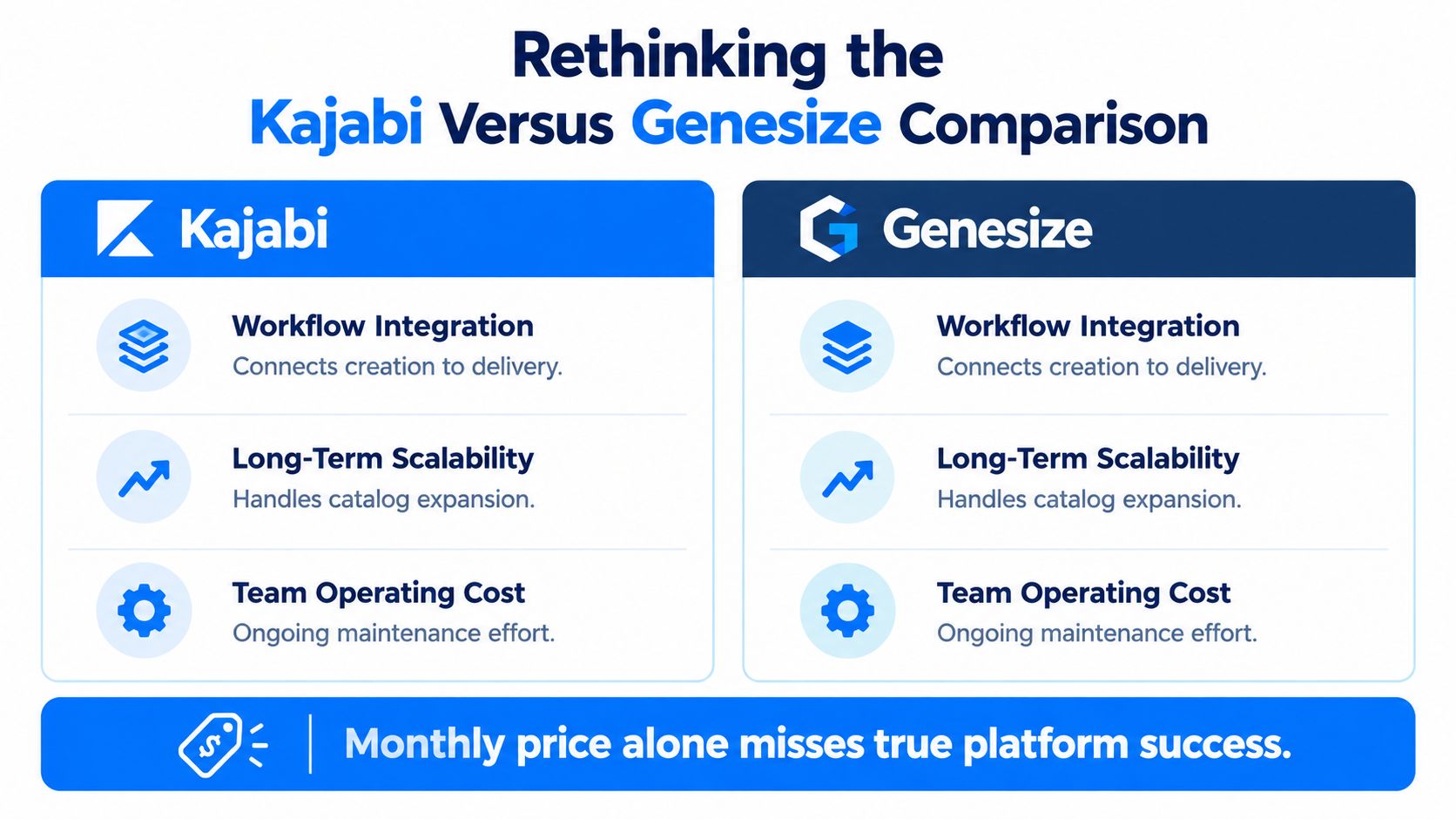
Rethinking the Kajabi Versus Genesize Comparison
What decides whether a digital product business scales cleanly, the feature list or the operating details behind it? The answer is usually the operating details. Total cost of ownership includes payment processing, currency friction, email setup, and the editorial effort required to get a product live. For that reason, a platform comparison that stops at subscription tiers misses the parts that shape margin and workflow.
The three questions that matter
First, what does each sale cost you? Kajabi publishes plan-dependent card-processing rates and platform fees that vary by plan and payment setup, so subscription price alone does not show the full bill (Kajabi pricing). A cheaper monthly plan can still carry higher transaction friction once sales volume rises.
Second, can your email system survive mailbox-provider rules? Gmail and Yahoo now require SPF, DKIM, and DMARC alignment for bulk senders, along with low spam complaint rates. A platform can look all-in-one and still create delivery problems if your domain governance is weak.
Third, who owns the knowledge and the final output? AI-assisted drafting can speed up production, but it also raises questions about source material, revisions, and disclosure. If the platform increases output while reducing authorship control, the workflow becomes harder to trust and easier to mismanage.
A practical comparison starts there. Kajabi and Genesize may share similar surface capabilities for workflow integration, scalability, and operating costs, but the decisive factor sits in how each platform handles revenue capture, inbox compliance, and content ownership. For experienced builders, those trade-offs matter more than a polished pricing page.
Understanding the Creator Economy Context and Growth Drivers
The creator economy now behaves more like a small-business market than an occasional publishing hobby. A market forecast estimated it at $149.4 billion in 2024 and projected growth to $1.0728 trillion by 2034, with a projected 21.8% CAGR from 2025 through 2034 (creator economy forecast). That kind of growth changes what a platform needs to do well. It has to help creators produce an offer, collect payment, deliver the product, track buyers, and follow up without forcing them to stitch together a stack of disconnected tools.
The broader online-learning market shows why the platform question is now more operational than decorative. One market estimate reported more than 900 million users worldwide in 2024, over 75% of universities across 120 countries using learning-management systems, and more than 50% of corporate-training hours delivered digitally in 2024, up from less than 20% in 2015 (online learning market). It also reported that mobile devices accounted for about 45% of course access and smartphone-based enrollments rose 25% between 2021 and 2024. That makes mobile-friendly delivery and scalable hosting essential.
For creators, this means two different product motions are emerging. Course-heavy businesses need solid learning delivery and membership logic. Expertise-driven creators who are starting from notes, samples, or methods need a faster path from raw knowledge to a sellable ebook, workbook, or course. Kajabi has historically sat in the first lane, while Genesize sits in the second, with an emphasis on turning expertise into a packaged product more quickly. Consolidation can reduce tool sprawl, but it doesn't automatically reduce cost.
The better question is whether your stack supports the way modern buyers consume and buy digital content. If your audience expects on-demand delivery and your business depends on repeatable offers, the platform has to support that operating model, not just display it well.
Genesize Workflow for AI-Assisted Digital Product Creation
The Genesize workflow starts with capture, not blank-page drafting. A creator stores notes, examples, and writing samples in an Expertise Library, then uses an AI interview to pull out methods, examples, and point of view. That matters because the system isn't just generating generic topic text, it's shaping output from the creator's actual material.

From source material to sale page
The first practical step is turning scattered expertise into a draft structure. Genesize combines drafting, layout, and cover comparison so the creator can move from raw notes to a product that looks coherent before export. Flexible exports to PDF and Word matter here, because they let a creator sell through other channels or refine the asset elsewhere if needed. For a close look at the workflow surface, the platform overview at Genesize shows how the workspace connects creation and selling.
Storefront, checkout, and follow-up
Once the product is shaped, the storefront and checkout are part of the same workspace. The platform uses Stripe checkout for payment processing, then connects access management, file delivery, and buyer records inside the CRM. Email campaigns, welcome sequences, and follow-ups can be tied to what buyers do, which keeps the launch process from becoming a patchwork of exports and imports.
A useful way to judge this workflow is whether it lowers setup drag without hiding the moving parts. The answer is yes, as long as the creator still reviews the final copy, checks the sales-page claims, and validates the delivery experience. AI can accelerate the production cycle, but it doesn't replace editorial judgment.
If your current process starts with a blank doc, a payment tool, and a separate email platform, the friction usually shows up right after launch.
Curriculum Templates and Blueprint Structures in Each Platform
Kajabi's strength has long been structured knowledge delivery. It's a natural fit for courses, memberships, and modular learning paths where lessons need to sit inside a repeatable framework. That makes sense for creators who already know their curriculum shape and want the platform to preserve it.
Genesize approaches structure differently. Instead of leading with a course shell, it starts with expertise capture and then turns that material into ebooks, workbooks, practical resources, or courses. That's useful when the creator's real challenge is not organizing an existing curriculum, but deciding what the curriculum should be in the first place.
Where the two models diverge
Kajabi is generally better aligned with nested lesson architecture, membership ecosystems, and future expansion into a more formal learning business. If your offer is built around series, cohorts, or premium access tiers, that structure is a practical advantage. It gives the product room to grow into a broader knowledge-commerce business.
Genesize is more useful when the starting point is a body of expertise, not a prebuilt syllabus. Its interview-driven workflow helps transform tacit knowledge into something publishable, which is often the bottleneck for first-time authors and consultants. The actual difference is portability of thinking, not just portability of files.
What to test before deciding
- Module logic: check whether your content naturally maps to lessons or whether it needs product-first formatting.
- Blueprint reuse: see whether templates save time without forcing awkward content reshaping.
- Future expansion: think about whether you may want memberships, communities, or layered access later.
- Content origin: decide whether the platform should preserve an existing curriculum or help invent one from scratch.
A short video walkthrough can be useful here because it reveals how quickly a creator can move from structure to publishable product.
The practical takeaway is simple. If you already have a strong course framework, Kajabi's historical strength is easier to exploit. If you're still turning expertise into a shaped digital product, Genesize is built around that first mile.
Payment Processing Costs and Total Cost of Ownership
Headline price is the easiest number to compare, and the least useful one. For a digital product business, real cost comes from subscription fees, platform transaction fees, processor charges, refund handling, and cross-border friction. The better question is simple, which setup leaves more net revenue after each sale?
Kajabi publishes plan-dependent card-processing rates for U.S. entities using Kajabi Payments, and it also explains additional platform fees for some third-party processor setups. Genesize routes checkout through Stripe, so the true cost depends on Stripe's country, currency, dispute, tax, and payment-method rules rather than one fixed platform fee. Creators should model the full payment path, not just the monthly bill.
A practical way to model cost
| Scenario | Example math | What usually drives cost | Best fit creator type |
|---|---|---|---|
| Low volume, one product | 100 sales/month at $29 = $2,900 gross. A 2.9% + $0.30 fee is about $114, before platform fees. | Fixed fees can dominate at this volume. | First-time ebook or workbook seller |
| Moderate volume, mostly domestic | Subscription plus percentage fees begin to shape margin. | Platform surcharges start to matter. | Solo creator with repeat launches |
| Higher volume, mixed geography | Currency conversion, refunds, and payment-method rules can outweigh software price. | International friction becomes harder to ignore. | Creator with global buyers |
That worksheet is more useful than a feature checklist. A creator selling one workbook to one market can optimize for a different cost profile than a business selling many low-ticket products across countries.
The right model is straightforward. Add the monthly platform fee, the transaction percentage multiplied by gross sales, the fixed fee multiplied by order count, and any international or automation overages. Then run the same assumptions across both platforms. A lower headline subscription means little if the loaded cost is higher at your real sales volume.
Email Deliverability Requirements and Domain Governance
Email automation is a deliverability problem first and a marketing feature second. Gmail and Yahoo now expect SPF, DKIM, and DMARC to be in place, and sender reputation depends on complaint control as much as copy quality. As noted earlier, a technical reference also points to complaint thresholds that high-volume senders should stay under, which is one more reason domain setup cannot be treated as an afterthought.
Kajabi and Genesize both sit inside the same reality. A custom sending domain has to authenticate correctly, and the list has to stay clean enough that complaints, bounces, and unsubscribes do not drag down inbox placement. A welcome sequence that lands in spam will not convert, even if the email looks polished in the editor.
What good governance looks like
A practical setup keeps several pieces aligned. The sender domain matches the visible brand domain. SPF and DKIM pass in the message headers. DMARC reports are reviewed instead of filed away. Promotional sends stay separate from transactional delivery messages. Unsubscribes and bounces are suppressed before the next campaign goes out.
Authentication does not make your emails good, it makes them eligible to be trusted.
That distinction matters in real operations. I have seen strong offers fail because the delivery path was weak, not because the content was poor.
Acceptance tests before scaling
- Header review: confirm SPF, DKIM, and DMARC alignment in inbox-provider headers.
- Unsubscribe handling: verify that opt-outs are immediate and reliable.
- Complaint monitoring: watch for reputation issues before sending to the full list.
- Transactional separation: keep buyer-delivery messages distinct from marketing campaigns.
- Export readiness: make sure contacts and consent records can be exported if you ever change platforms.
The practical standard is simple. Send authenticated messages to the major mailbox providers, confirm the headers pass, then scale only after the list stays clean. At that point, the feature list matters less than whether your mail arrives.
AI Authorship, Provenance Controls, and Compliance Risks
Speed is the wrong primary metric for AI-assisted product creation. The more important questions are who supplied the knowledge, how the draft was shaped, and whether the creator can prove what came from them versus what came from the system. That matters because recent reporting notes that dozens of AI-related copyright cases had been filed by January 2026, while EU AI Act transparency obligations for certain synthetic content take effect on August 2, 2026 (AI copyright and transparency reporting).
Provenance beats raw drafting speed
A platform that interviews the creator, stores writing samples, and keeps source materials separate from generated text gives the user more editorial control. That control becomes important when the product contains coaching methods, educational claims, or original frameworks that reflect real expertise. If the source material is messy, the final product tends to feel generic no matter how fast it was produced.
Revision history and export control also matter. Creators should be able to review what changed, keep ownership of final files, and decide where the finished product lives. That protects the work if the creator later wants to move the product into a different system or distribute it directly.
What to scrutinize before trusting AI output
You don't need more templates. You need governance.
- Source privacy: keep creator notes and samples isolated from public output.
- Revision tracking: preserve a record of what was edited by the human author.
- Attribution clarity: know which claims need verification before they're published.
- Export ownership: keep final files usable outside the platform.
- Disclosure readiness: be prepared to label synthetic or heavily assisted material where required.
A generic AI writer can shorten setup time and still increase reputational risk if it produces unverified claims or a voice that feels unlike the creator. The better platform is the one that protects authorship while speeding production, not the one that just drafts faster.
Choosing the Right Platform for Your Digital Product Business
The cleanest choice depends on what kind of business you're building. If you're running a course-heavy operation with memberships, structured learning paths, and recurring customer engagement, Kajabi fits the mature knowledge-commerce model more naturally. If you're starting from expertise and need help converting raw knowledge into an ebook, workbook, or course, Genesize is built around that transformation process.
Audience geography changes the answer too. If your buyers are international, payment and currency friction deserve more weight than a glossy pricing comparison. If your product is sensitive, original, or method-heavy, authorship controls and revision governance matter more than template volume. And if your email system is central to revenue, authentication and list hygiene can't be left to chance.
A simple decision filter
Use the platform that best matches your current bottleneck.
- Choose Kajabi if your primary need is mature course delivery, memberships, and a long-term learning-business framework.
- Choose Genesize if your primary need is faster conversion from expertise into a sellable digital product with creation, storefront, checkout, and follow-up in one place.
- Re-check costs if you sell across borders, because loaded payment cost can outweigh subscription price.
- Re-check compliance if your email list or product claims carry reputational risk.
The right platform isn't the one with the longest feature list. It's the one that makes your current workflow cleaner without creating hidden operational debt.
If you're turning expertise into ebooks, courses, or practical resources, Genesize is built to help you move from idea to product without stitching together a dozen tools. It combines AI-assisted creation, storefront, checkout, email, CRM, and analytics in one workspace, which makes it a strong fit for the workflow this comparison is really about. Visit Genesize to see how it handles digital product creation from start to finish.
Written with Outrank tool