How to Sell Ebooks Online Without Relying on Marketplaces
Learn how to sell ebooks online with a focused strategy covering storefront setup, pricing, sales pages, email funnels, and promotion that drives real revenue.

Most advice on how to sell ebooks online starts in the wrong place. It tells creators to list everywhere, post more, and wait for momentum, as if visibility alone turns a file into a business. In practice, the first sale usually comes from a narrower system: one specific audience, one clear promise, one checkout path, and one follow-up sequence that you can measure.
That matters because the market already shows that ebooks are established, but not automatic. U.S. ebook revenue remains substantial even as share shifts with other formats, and reader behavior still includes free sources, libraries, and subscriptions as real alternatives. If the buyer can get a similar outcome without paying, the offer has to earn its place.
Why Most Ebook Sales Advice Leaves Money on the Table
The usual playbook assumes the bottleneck is attention. Post on social, list on a marketplace, optimize a thumbnail, then hope the right reader appears. That approach can create activity, but it doesn't tell you which part of the system is weak when sales stall.
The better starting point is a measurable distribution loop. One audience. One promise. One owned path to follow up with people who already showed interest. When those pieces are clear, you can tell whether the problem is the offer, the page, the email sequence, or the audience itself.
The real issue is usually conversion, not just reach
Most first-time sellers don't need a wider audience before they need a sharper offer. A vague ebook title can attract clicks and still fail to convert because the reader can't tell what outcome they're buying. A focused promise, by contrast, gives you something concrete to test against buyer behavior.
Practical rule: if you can't explain why someone should pay for your ebook instead of bookmarking a free article, the page isn't ready.
That's the shift most marketplace-first advice misses. Discoverability matters, but discoverability without conversion measurement just creates noise. If you're not tracking who clicked, who subscribed, who bought, and which message moved them, you're guessing.
A useful pressure test is simple:
- Who is this for? Not “creators” or “busy people,” but a specific reader with a recognizable problem.
- What changes after they read it? A result, a process, or a decision they can apply quickly.
- Why pay now? A workbook, template, shortcut, clearer method, or faster implementation.
- What happens after purchase? A page, an email path, and delivery that don't depend on luck.
The goal isn't to reject marketplaces forever. It's to stop treating them as the strategy itself. An ebook sells better when the product and the distribution path were designed together.
What the Ebook Market Actually Looks Like in 2024 and 2025
The market gives a mixed signal, and that's useful if you read it accurately. Preliminary 2024 U.S. publishing data reported by Publishers Weekly found that overall book-publishing sales rose 6.5%, while ebook sales grew 5.3%. Ebook sales were 20% of total publishing sales in 2024, down from 21.6% in 2023, which shows that ebook revenue can rise even as share slips when other formats grow faster. Publishers Weekly's preliminary 2024 report makes one thing clear, ebooks are still a major channel, but they're not the whole market.
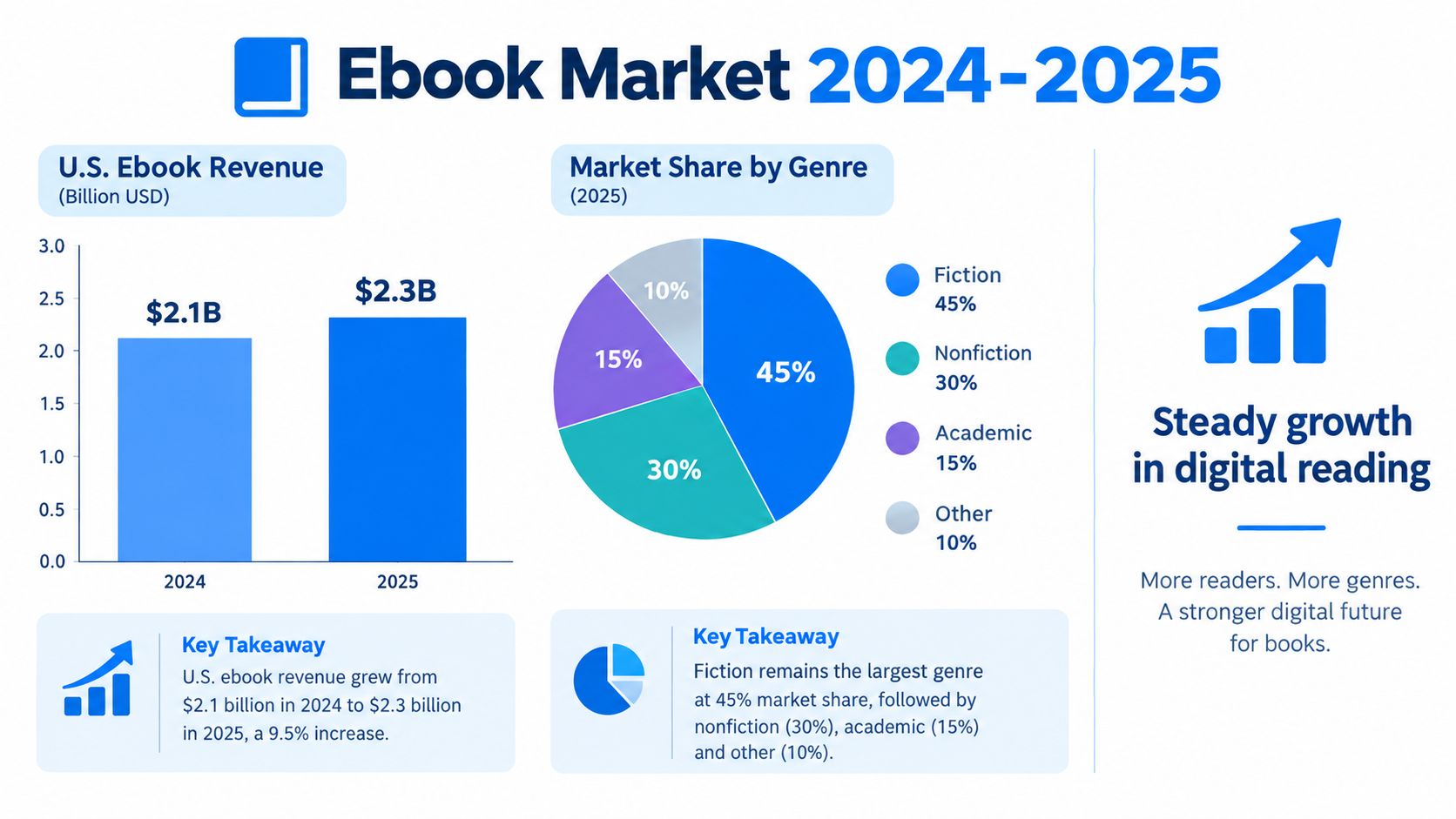
A second dataset shows why paid offers need more than availability. BookNet Canada's 2024 leisure and reading study found that 40% of ebook readers purchased books during the year, while 57% obtained books from a free source and 22% identified the public library as their preferred source. Paid purchasing was split across online retailers or retailing apps at 20%, subscription services at 13%, and general retailers at 7%. BookNet Canada's 2024 study makes the commercial point bluntly, ebook reading and ebook buying are not the same behavior.
What that means for a seller
If readers can borrow, subscribe, or grab a free copy instead, your product has to justify payment. That doesn't require gimmicks. It requires a reason to buy, such as practical implementation steps, original frameworks, worksheets, checklists, or a cleaner path to solving a problem.
The buying reality also explains why a sales page can't just describe the file. The page has to answer why this book is worth paying for now, in this format, from this seller. If that answer is weak, the offer leaks even when traffic is decent.
The same data shows something else useful. More people are reading ebooks, but that doesn't mean every reader is a buyer. For a creator, the opportunity is real, but the tactic has to be specific.
Picking a Specific Problem Worth Paying For
A lot of ebook ideas die because they start as topics instead of offers. “Productivity,” “marketing,” and “mindset” sound broad enough to attract interest, but they're hard to sell because the buyer can't see a fast, obvious use case. A tighter promise feels more credible because it points at a problem, a context, and an outcome.
Narrow the reader before you narrow the content
One useful filter is to define the person first, then the job they need done. A new manager, a freelance designer, a consultant building a lead magnet, a parent organizing school routines, or a coach packaging a method are all different buyers. The ebook should feel like it was written for one of them, not for everyone who might someday need it.
Weak promise, strong promise:
- Weak: a guide to productivity.
- Stronger: a 14-day reset for new managers inheriting a struggling team.
- Weak: ebook marketing tips.
- Stronger: a launch system for first-time consultants selling one paid workbook.
- Weak: better habits.
- Stronger: a simple planning method for remote workers juggling client deadlines.
The stronger version doesn't just sound clearer. It also gives you a better price justification because the buyer can see the use case immediately.
Validate the problem before writing the draft
Look for language people already use when they describe the problem. Sales calls, comments, support emails, community posts, and search queries are all useful because they show how the issue is framed in the wild. Competitor pages help too, especially where they stay generic or leave a question unanswered.
If three different people describe the same pain in different words, you probably found a real offer.
A quick validation check can keep you from writing the wrong book:
- Name the buyer. Keep it to one primary person.
- Name the pain. Use the phrase they'd use, not your internal category.
- Name the outcome. Make it observable, not abstract.
- Name the shortcut. Explain what your ebook helps them do faster or more confidently.
- Name the proof. Add examples, templates, or steps that show the method works.
The biggest mistake is trying to be broadly useful before being specifically useful. Specificity doesn't limit the market as much as it clarifies the purchase. Readers buy when they can see themselves in the problem and see the path out.
Setting Up Your Storefront, Checkout, and Delivery
The operational stack matters because weak setup creates silent friction. I've seen creators spend weeks stitching together a page builder, cart, payment processor, file delivery tool, and email platform, then wonder why launches feel brittle. Every extra tool adds another place where a buyer can get confused or a file can break.
Hosted storefront or stitched toolkit
For a first ebook launch, the cleanest default is a hosted storefront with one-time checkout and automatic delivery. That setup keeps the product page, payment flow, and access management in one place, which makes it easier to test a single offer without moving parts everywhere. A stitched toolkit can work, but it usually asks you to manage more decisions before you've collected enough sales data to justify them.
| Decision | Hosted storefront | Stitched toolkit |
|---|---|---|
| Setup | Faster to publish one product page | More steps across separate tools |
| Ongoing maintenance | Fewer moving parts to monitor | More places for links, taxes, and delivery to break |
| Refund handling | Centralized with one system | Spread across multiple services |
| Best use case | First launch, one offer, one follow-up path | Larger catalog or custom stack needs |
If you want a reference point for a single-workspace setup, this overview of an all-in-one digital product platform shows the category plainly. One option in that category is Genesize, which combines storefront, checkout, email, CRM, and file delivery in one workspace.
Keep the first checkout boring
You don't need subscriptions, bundles, or complicated upsells on day one. A one-time price, a clear product page, and clean delivery are enough for the first test. Stripe-based checkout works well because buyers already understand the payment flow and you can keep the purchase path simple.
The hidden failure points usually show up after launch:
- Refund flows become messy when the cart and delivery live in different tools.
- Download links break when file hosting and checkout don't sync cleanly.
- Tax handling becomes a distraction if each service calculates differently.
- Buyer access gets harder to manage when people purchase from multiple systems.
A practical launch checklist looks like this:
- Product page published with one clear promise.
- Payment connected with a one-time checkout.
- File delivery tested on desktop and mobile.
- Confirmation email checked for clarity and links.
- Buyer access verified from the customer side.
The default choice for a first launch should favor reliability over flexibility. You can always split the stack later if the product proves demand. Until then, the fewer systems you depend on, the fewer ways the sale can fail.
Pricing Your Ebook and Choosing the Right File Formats
Price sends a signal before the reader finishes the headline. Too low, and the ebook can look disposable. Too high, and buyers need stronger proof that the content solves a real problem faster than the free material they already have.
Price for the outcome, not the page count
The right number depends on what the buyer believes they are buying. A short overview needs a modest price. An ebook with a framework, templates, implementation steps, or a usable system can command more because the reader is paying for speed and clarity, not just words.
I usually sort ebook pricing into three signals:
- Convenience for quick answers and a low-friction purchase.
- Certainty for a clearer path than piecing together free content.
- Transformation for an offer that helps the buyer act, not just learn.
Pick one anchor and keep the promise aligned with it. If the page sells a system, do not price it like a casual pamphlet. If it is a lightweight lead-in offer, do not force a premium signal onto something meant to stay simple.
Useful test: if the buyer would still be happy after skimming the whole file in one sitting, the price should match that expectation.
Choose the format the reader can actually use
Format matters because readers use digital files differently. A fixed-layout PDF works well for workbooks, visual guides, and products where design is part of the value. A reflowable EPUB fits better when the reading experience should adapt across devices and text sizes.
Accessibility is part of the product, not a side note. Recent Canadian reading research found that 75% of ebook readers at least sometimes adjust font or spacing, 71% adjust screen magnification or zoom, and 73% use the table of contents for navigation. BookNet Canada's 2025 research points to a clear pattern. Buyers need files that work for them, not just files that open.
That means the file should support:
- Selectable text for copying, highlighting, and screen readers.
- Logical headings so navigation makes sense.
- Readable contrast for different viewing conditions.
- Descriptive links and clear labels.
- Mobile testing before you release it.
A smart compromise is to sell the main ebook with a companion version. A printable worksheet, a text-first EPUB, or a quick-start guide can make the purchase easier to use without forcing every reader into the same format. If the product depends heavily on layout, a PDF can still be the right core file, but it should not be the only experience you think about.
If you want a comparison of tools that handle pricing, delivery, and format exports in one place, see this 2026 digital product tool overview.
Writing a Sales Page and Email Sequence That Converts
A sales page needs to sell the decision, not just describe the product. Most weak pages are feature lists in disguise. They tell the reader what's included, but they don't give enough reason to believe the ebook is the right purchase right now.
Build the page around buyer questions
The page has four jobs. It has to define the problem, show the outcome, reduce doubt, and make the next step obvious. If one of those jobs is missing, the page may get traffic without getting sales.
A simple page structure works better than a fancy one:
- Promise block with a specific outcome and a specific reader.
- Problem block that mirrors the buyer's current frustration.
- Solution block showing what the ebook helps them do.
- Proof block with examples, excerpts, or a preview of the method.
- Buy block with a clear CTA and delivery details.
The language should sound like a real seller talking to a real buyer. “Learn productivity strategies” is flat. “Reset how you plan your week without adding another system to manage” gives the reader a reason to keep reading.
Use email to warm the lead, not exhaust them
A short sequence can do a lot of work if the timing is right. Education emails should answer the questions that keep prospects from buying, while launch emails should make the purchase easy without sounding pushy. If the list is small, that sequence matters even more because every contact is precious.
A clean three-email flow usually covers:
- Email 1. Why the problem matters and what the reader gets wrong about it.
- Email 2. The method or framework behind the ebook.
- Email 3. The offer, the outcome, and the easiest next step.
The content doesn't need to feel aggressive. It needs to remove hesitation. A buyer who understands the problem, trusts the method, and can see the file as useful is much closer to purchase than someone who only saw a headline on social media.
Use your email sequence to reinforce the same promise from the sales page. If the page promises speed, the emails should show how the ebook saves time. If the page promises clarity, the emails should reduce confusion instead of adding more content. Consistency is what turns interest into a decision.
A 30-Day Test Loop That Replaces Guesswork
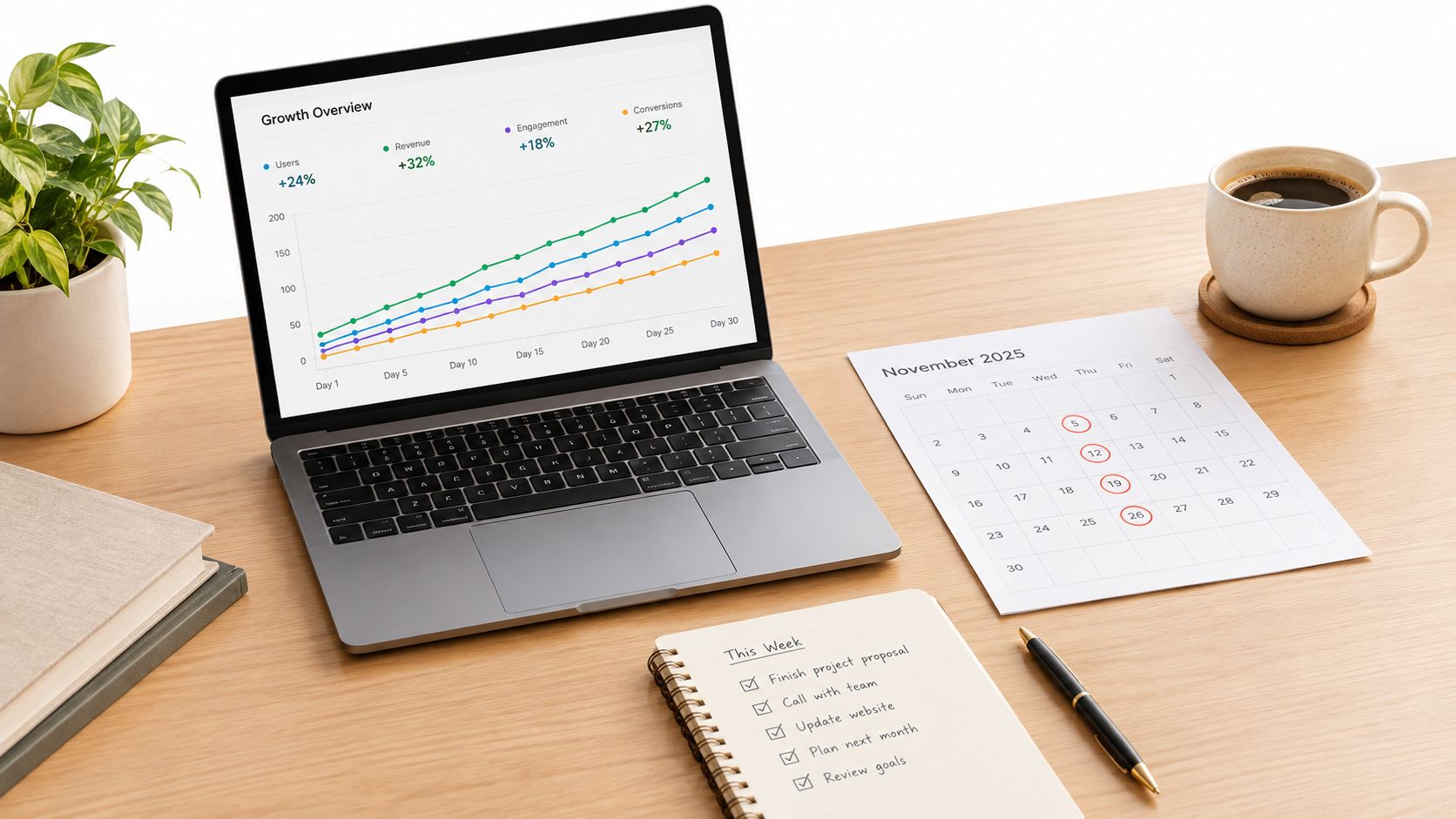
Launching an ebook without a measurement loop is just hoping with extra steps. You don't need a giant analytics stack, you need a handful of numbers that tell you where the system is leaking. The point is to find the weak link fast enough to adjust while the launch is still alive.
Track the few metrics that matter first
Start with four signals:
- Landing-page conversion tells you whether the page creates enough interest to move forward.
- Email-to-purchase conversion tells you whether follow-up is doing real work.
- Refund rate tells you whether the promise matched the actual product.
- Revenue per subscriber tells you whether the list is worth the attention you're giving it.
If one of those lags, the fix points to a different part of the system. Low landing-page conversion usually means the offer is unclear or the audience is too broad. Weak email conversion usually means the sequence isn't addressing objections. Refunds point back to the promise, the content, or the format.
Here's the decision logic I use:
- Revise the offer if readers like the topic but don't buy.
- Tighten the audience if clicks come from people who aren't the right fit.
- Rework the sales page if traffic arrives but doesn't convert.
- Adjust promotion intensity if the page converts but reach is too thin.
Run the launch like an experiment
The first 30 days are about learning, not declaring victory. Publish the ebook, send the email sequence, watch buyer behavior, and make one change at a time. If you change the title, price, page, and sequence all at once, you won't know what caused the result.
Keep the loop simple enough that you can repeat it. The best early launches don't feel flashy. They feel controlled, measurable, and honest about what the market said.
Genesize gives independent creators one place to draft an ebook, publish a storefront, connect checkout, send email follow-ups, and track buyer activity without stitching together a scattered stack. If you're building a first paid offer and want a measurable way to test it, visit Genesize and compare how a single-workspace launch changes the way you sell.