Genesize vs Kajabi: Which Platform Fits Your Launch
Genesize vs Kajabi compared across onboarding, AI drafting, checkout, email, exports, and migration. Find out which fits your first digital product launch.

Stop buying the platform with the longest feature list. That's the most popular advice in creator forums, and it's backwards for a first launch. Features you don't use for six months don't make you money. A finished product, a live checkout, and a buyer who receives the file do. Judge Genesize vs Kajabi by time to first sale, not by who wins a spreadsheet.
Why Feature Checklists Miss the Point
Most comparisons line up course builders, websites, email, and payments, count the boxes, and crown a winner. That tells you what exists. It doesn't tell you how much work you'll do before anyone can pay you.
The Only Test That Matters Early
Run a timed novice launch test. Take the same source material, the same price, and the same small audience into both platforms. Clock every step. Structuring the topic. Drafting chapters or lessons. Designing a cover. Writing the sales page. Configuring checkout, delivery, and follow-up email.
The platform that looks weaker on paper often wins that test because your bottleneck isn't scale. It's productization. You know your subject, but you don't have an outline, a manuscript, lessons, or a funnel. A mature tool built for operators who already have content can hand you more control and more unfinished tasks at the same time.
My rule: If a platform requires you to become a designer, copywriter, and funnel builder before launch, its feature depth is costing you revenue, not creating it.
That's the lens for everything below. Don't ask which system can eventually do more. Ask which one gets a nontechnical expert from raw knowledge to a published, paid offer with the fewest handoffs. For an established business, that answer changes. For a first ebook, workbook, or compact course, speed and completion beat theoretical power every time.
Platform Background and Operating History
Kajabi is the incumbent, and you should respect what that means. Kajabi was founded in Irvine, California, in 2010 by Travis Rosser and Kenny Rueter, built around an integrated system for publishing and monetizing knowledge instead of stitching together a website, course host, payment tool, and email service.

Scale You Can Verify
By February 2022, Kajabi reported 51,000 active users across 138 countries, and by February 2025 its users had generated more than $9 billion in cumulative sales, according to the same history linked above. Read those figures correctly. They're platform milestones, not average creator income and not a guarantee for your launch.
Genesize comes from a different starting point. It's a newer platform built around AI-assisted creation of ebooks, courses, and practical resources, connected to a storefront, checkout, email, CRM, and analytics. It doesn't try to out-history Kajabi. It tries to shorten the distance between expertise in your head and a sellable asset.
That difference in origin explains the product decisions you'll feel daily. Mature platforms optimize for infrastructure, catalogs, and operators who are already selling. Newer productization tools optimize for getting the first offer built. Neither priority is wrong. Picking the wrong priority for your stage is expensive.
Market Size and the Typical Creator Profile
You're probably not building an education empire on day one. The market data says most creators aren't, either.
A Large Market Made of Small Operators
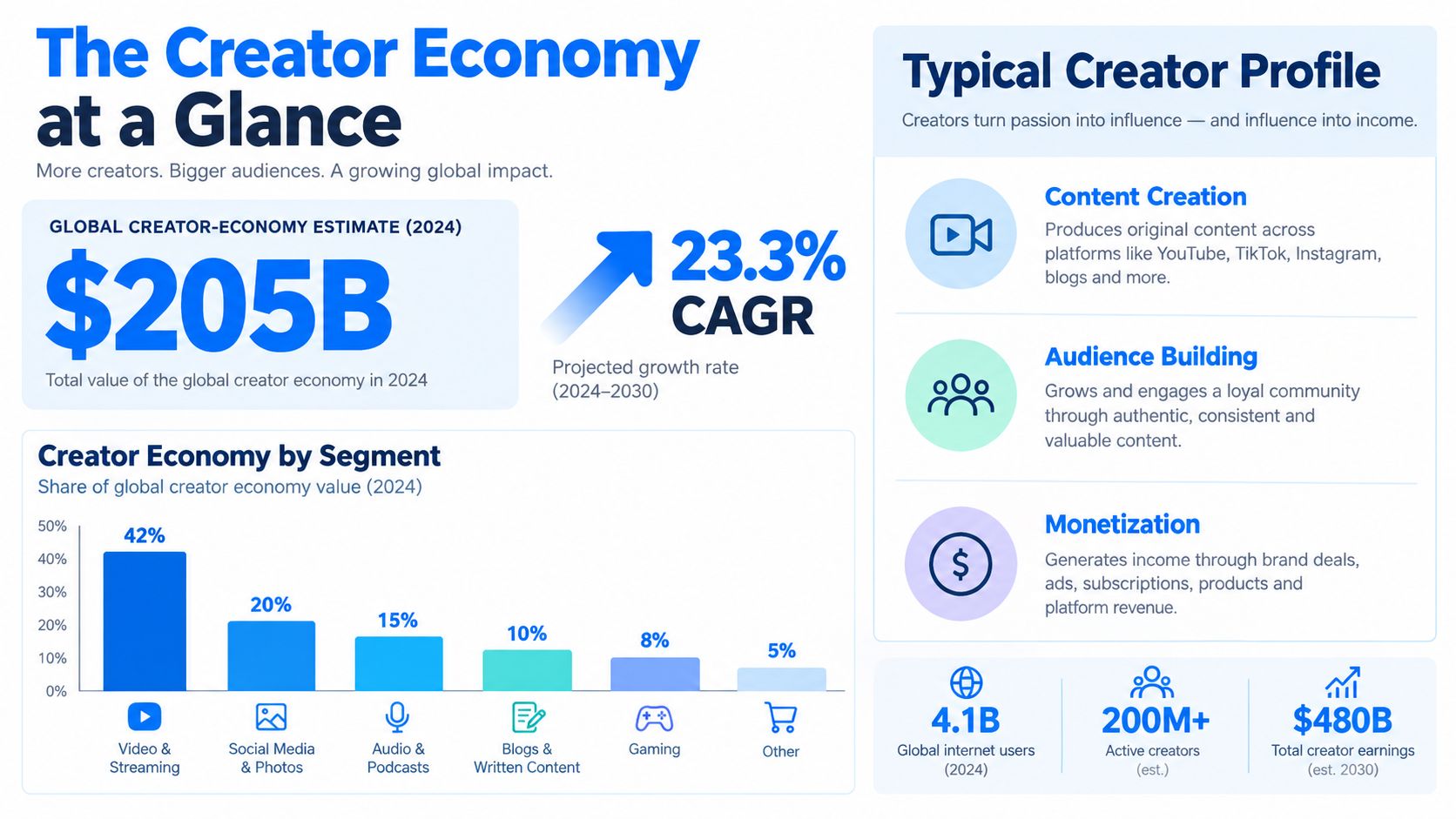
A 2024 estimate placed the global creator economy at approximately $205 billion, with projected compound annual growth of 23.3% through 2033. Research summarized in 2026 reported more than 200 million people worldwide identify as content creators, and 67% of monetizing creators sell digital products such as courses, ebooks, templates, memberships, and coaching, according to that same summary.
Now look at the typical seller inside that huge market. In a survey of 1,128 course creators, 85.8% charged less than $100 for their primary course and 82.5% had served fewer than 300 students, based on figures in the summary above.
That profile changes the buying decision. If you're an independent expert, coach, consultant, or first-time author with one offer and a small list, you don't need enterprise throughput. You need low setup friction, clear pricing, and help finishing the product.
- Small catalog reality: One validated offer beats an empty library with room for fifty products.
- Small audience reality: Simple checkout and follow-up matter more than advanced segmentation you'll barely use.
- Small team reality: You're the author, marketer, and support desk, so every extra configuration screen competes with selling time.
Kajabi serves the upper end of this market well. Genesize aims at the much larger entry point, where the first product still needs to be created.
Product Creation Workflow Compared
Genesize vs Kajabi stops being close for a first-time author.
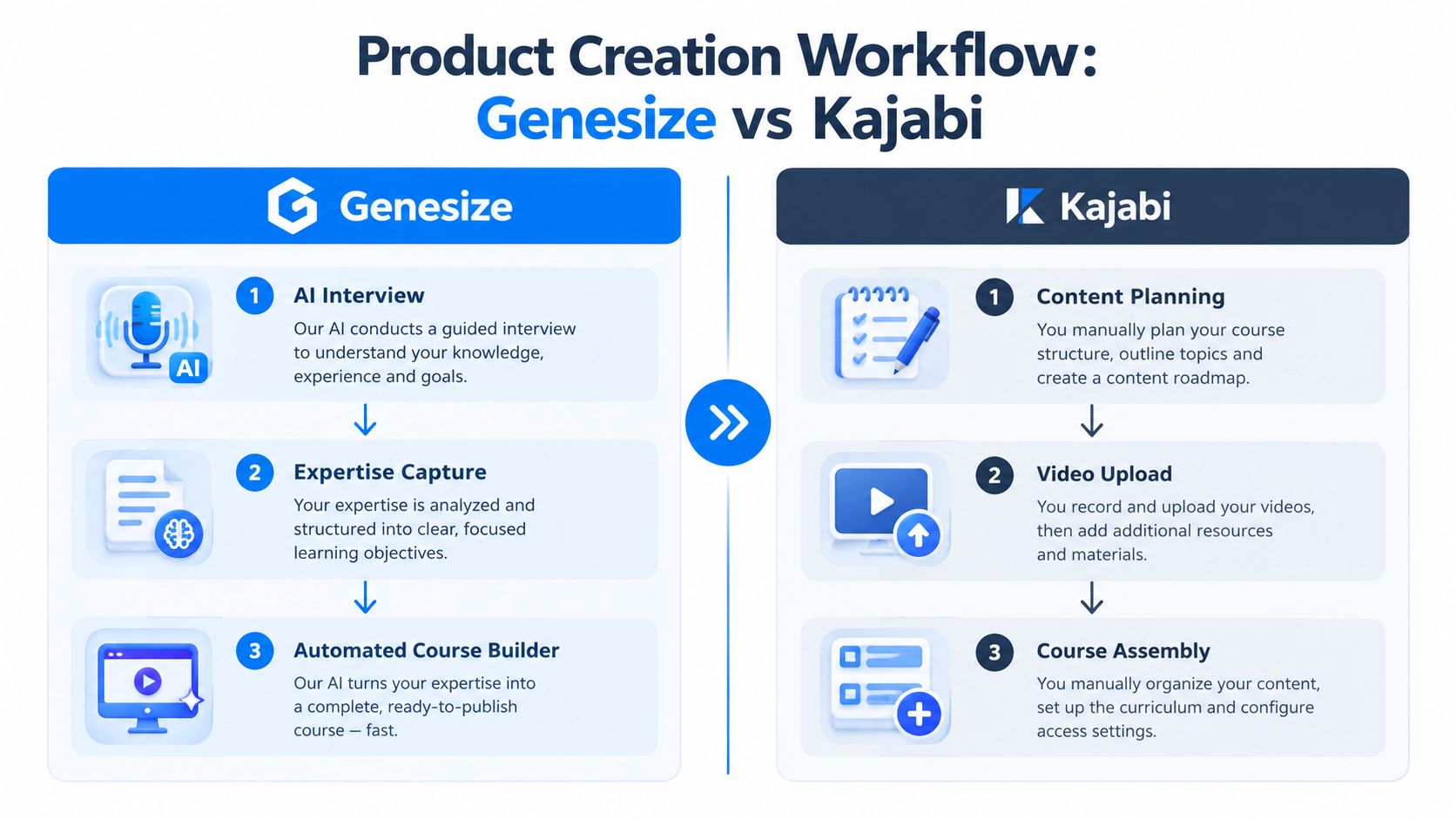
Genesize is positioned around AI-assisted production of ebooks, courses, and downloadable resources, then connects those assets to a hosted storefront, Stripe checkout, file delivery, email automation, CRM segmentation, and sales analytics. Kajabi is generally evaluated as a creator-business platform centered on hosted courses, memberships, communities, marketing, and customer management.
Genesize Starts With Your Knowledge
You begin with an AI interview that captures your methods, examples, and perspective. Notes and writing samples go into an Expertise Library, so drafting pulls from your material instead of generic prompts. You then edit chapters or lessons, compare cover designs, draft the sales page from product content, and export to PDF and Word if you want another sales channel.
Kajabi Starts With Your Content
Kajabi assumes you largely know what you're building. You assemble courses or memberships inside a branded environment built for hosting, community, and ongoing customer management. That gives experienced creators control. It also leaves outlining, writing, recording, and structuring on your desk.
If you're planning your first launch sequence, read this guide on how to launch an online course and notice how much work sits before publishing. Genesize compresses that front half. Kajabi strengthens the back half once content already exists. Don't confuse the two jobs.
Storefront Checkout and Buyer Delivery
Judge commerce by control, not by page templates. A pretty storefront that makes refunds, pricing changes, or reconciliation painful will annoy you long after launch week.
Use Stripe as Your Benchmark
Stripe's model separates a product, which represents what you sell, from a price, which defines the amount and charging frequency, including one-time or recurring structures. Test both platforms against that logic.
- One-time pricing: Can you create, change, and retire a one-time price without rebuilding the product?
- Recurring pricing: Can you add a subscription later without migrating buyers by hand?
- Fulfillment status: Can you see who paid, who received access, and who needs help?
- Refunds and reconciliation: Do platform records match your payment records cleanly?
Genesize fits the one-time purchase cleanly. You publish to a hosted storefront, take payment through Stripe checkout, and deliver the file or product access to the buyer. PDF and Word exports also let you sell the same asset elsewhere, which reduces channel lock-in for downloadable products.
Kajabi's strength appears when recurring revenue is the model from the start. Memberships and ongoing education offers need recurring billing, continued access management, and a persistent customer environment. If that's your business on day one, weigh that heavily.
My recommendation stays simple. Selling a focused ebook, workbook, or compact course for a single payment? Optimize for one-time checkout and portable files. Selling access that must continue month after month? Optimize for recurring infrastructure.
Email Automation as a Compliance System
Don't evaluate email by how pleasant the sequence builder feels. Evaluate it by whether you can send legally, suppress correctly, and prove what happened.
The Baseline You Must Meet
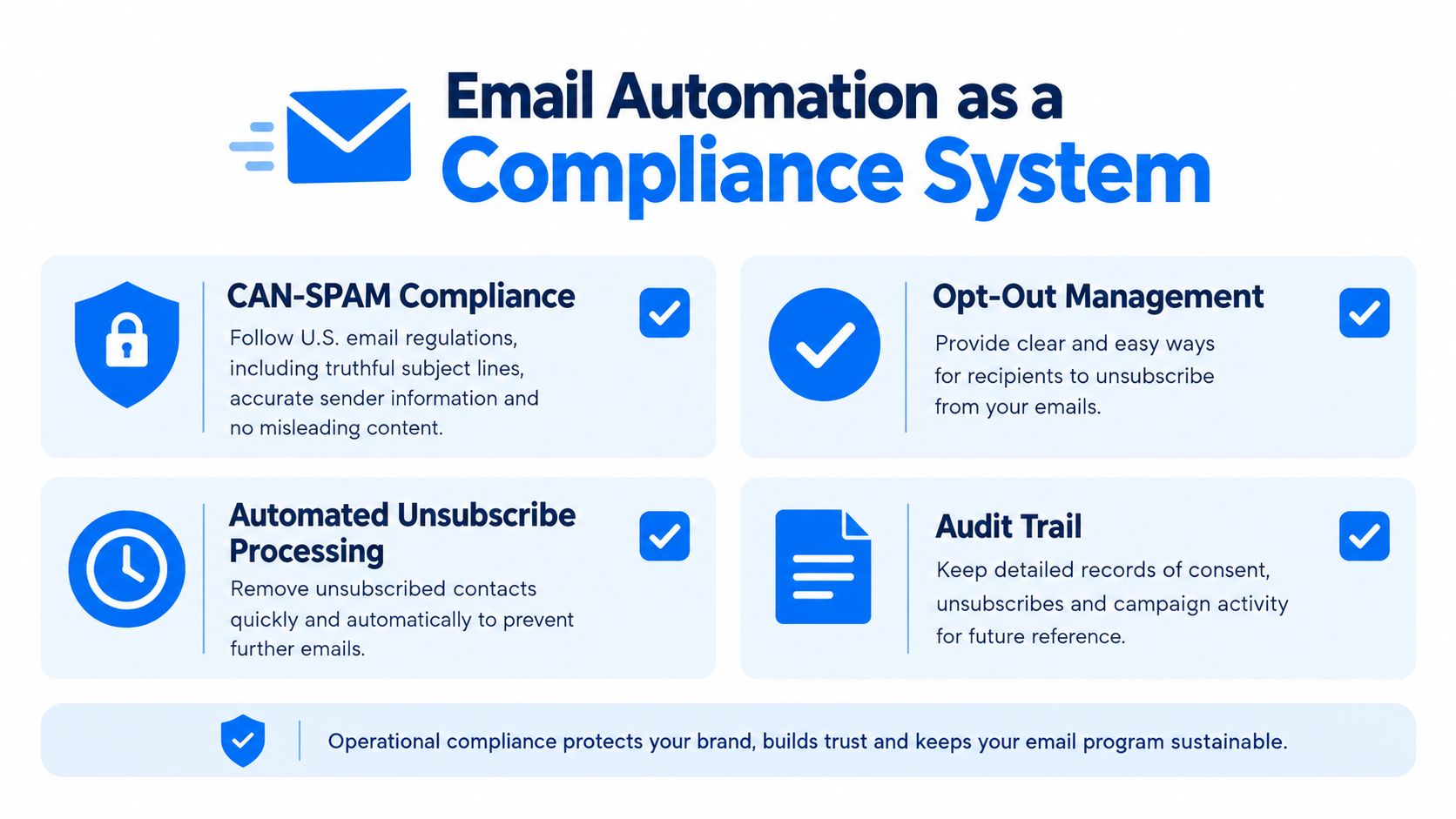
For U.S. commercial campaigns, the FTC says CAN-SPAM applies to messages whose primary purpose is advertising or promoting a commercial product or service, and requires accurate routing information, a clear opt-out mechanism, and a valid physical postal address. You must honor opt-out requests promptly, and misleading header information is prohibited even for transactional or relationship messages, according to that guidance.
Run This Lifecycle Test Before You Send
Use a test contact and walk through lead capture, welcome email, product promotion, purchase confirmation, download or access email, unsubscribe, and resubscribe. Don't skip the uncomfortable steps.
- Suppression: Does an unsubscribe apply across every segment, not just one list?
- Transactional delivery: Can a buyer who opts out of marketing still receive delivery or account messages?
- Sender identity: Can you configure From details and your postal address correctly?
- Reporting: Can you separate delivered, bounced, opened, clicked, unsubscribed, and converted recipients?
Do not send to a real audience until a test buyer can purchase, receive the product, unsubscribe from marketing, and still be handled correctly.
Apply this test to both platforms. The winner is the one whose behavior you can document, not the one with the prettier automation canvas.
Mapping Creator Bottlenecks to Platform Features
Your bottleneck should pick your platform. Not your ambition, not a guru's stack, and not a feature table.
Creators report marketing as their largest challenge at 34.5%, followed by narrowing the topic and teaching method at 18.5%, managing technology at 16.8%, and finding enough creation time at 16%. Score yourself against those four problems.
Creator Bottlenecks and Platform Responses
| Reported Obstacle | Share of Creators | Genesize Response | Kajabi Response |
|---|---|---|---|
| Marketing | 34.5% | Sales page drafted from product content, storefront, email follow-up, activity-based recommendations | Broader marketing and customer management infrastructure for established sellers |
| Topic and teaching method | 18.5% | AI interview and Expertise Library help structure knowledge | Templates assume you bring a clearer content plan |
| Managing technology | 16.8% | Creation, checkout, delivery, email, and CRM in one workspace | Integrated business infrastructure with more operating surface to configure |
| Creation time | 16% | AI-assisted drafting and PDF and Word exports | Strong hosting after you produce the content |
If your top two problems are topic structure and creation time, Genesize addresses the actual constraint. If your product is finished and your problem is running a larger education business, Kajabi's depth becomes relevant.
For a wider scan before you decide, compare your shortlist against this overview of the best all-in-one platform for digital products in 2026. Then come back to your bottleneck score. Don't buy relief for a problem you don't have.
When an Ebook or Workbook Beats a Course Platform
You might not need a course platform yet. Many creators buy one because they think serious businesses start with video lessons, modules, and a member area. Buyers don't care about your format. They care whether the asset solves a specific problem.
Courses Carry a Heavy Production Cost
In one recent study, 80% of faculty said online course development required significantly more effort than preparing an in-person course. That effort includes structuring, producing, and maintaining material in a format buyers may never finish.
A focused ebook or workbook is often the smarter first test. You can validate the topic, price, and audience before committing to recording, lesson management, community moderation, and ongoing updates. If nobody buys the workbook, you've learned cheaply. If it sells, you have proof, testimonials, buyer questions, and revenue to fund a course.
Genesize supports that staged path with one-time storefront pricing, Stripe checkout, file delivery, email sequences, CRM, analytics, and exports you can reuse elsewhere. This practical breakdown of how to sell ebooks online shows why the format works as a first paid offer or lead-generation asset.
Choose Kajabi when the branded learning environment is the product, when recurring access is central, or when your catalog has outgrown single assets. Don't start there just because the end state looks impressive. Earn your way into complexity.
Pre-Commitment Checklist for Either Platform
Before you pay for either platform, verify how you'll leave. Creators skip this because migration feels distant. It stops feeling distant the first time pricing, features, or strategy changes.
Verify Control in Writing
- Exportability: Can you export content, files, buyer records, and order history in usable formats?
- Buyer-data ownership: Do you control customer records, tags, and segments outside the platform?
- API and webhook access: Can your other tools receive purchase, refund, and contact events?
- Checkout customization: Can you control prices, product details, and post-purchase flow enough for your offer?
- Tax handling: Who calculates, collects, reports, and documents taxes for your markets?
- Migration procedure: Is there a documented exit path, or will you rebuild manually?
Run one real lifecycle campaign with test contacts before launch. Document suppression behavior between marketing and transactional messages. Screenshot the settings. Save export samples. Test a refund.
Then model total cost and launch time, not feature count. Include platform fees, transaction costs, your production hours, and any extra tools you'll still need. The cheaper subscription loses if it adds weeks of unpaid setup work. The larger platform loses if you pay for infrastructure your first offer never touches.
Matching Creator Profiles to the Right Platform
Here's my direct call by profile. Find yourself, start there, and stop reopening the decision every week.
Choose Genesize If This Is You
You're an independent creator, coach, consultant, or first-time author with expertise but no finished product. You need help turning methods and examples into an ebook, workbook, or compact course, then selling it through a storefront with checkout, delivery, email, CRM, and follow-up recommendations in one workspace.
You're a small business owner using a guide as a lead magnet or low-priced entry offer. You want a one-time PDF or Word product live quickly, with buyer records you can segment afterward.
You're an agency or creator partner building launches for clients. Exportable deliverables and a staged creation workflow let you hand over assets cleanly and repeat the process.
Choose Kajabi If This Is You
You're an established educator or membership operator with validated content and an audience that already buys. You need a branded learning environment, recurring offers, community, and deeper marketing and customer infrastructure.
You aren't choosing forever. You're choosing the right starting constraint. First-time sellers should optimize for finishing. Established operators should optimize for running and expanding what already sells.
Glossary of Platform and Compliance Terms
AI-assisted drafting means software helps turn source material into editable chapters or lessons. Expertise Library stores notes and samples used for drafting. Hosted storefront is a product page provided by the platform. Stripe checkout processes payment. Suppression stops marketing to opted-out contacts. Transactional messages confirm purchases or delivery. Promotional messages advertise offers. CAN-SPAM is the U.S. commercial email law. API and webhook connect tools and send event data. Buyer-data ownership means you can export and reuse customer records.
Frequently Asked Questions
Can I Export Content and Buyer Data Later
Test it before you commit. Export a sample product, file, contact list, and order record from each platform, then open those files outside the system. Genesize's PDF and Word exports help with downloadable assets. For any platform, confirm customer records and content extraction in writing.
Is CAN-SPAM Enough Outside the United States
No. Treat it as a U.S. baseline only. Add the consent, privacy, retention, and electronic marketing requirements for every market where your buyers live. Your platform settings don't replace legal advice for international selling.
Can a One-Time Ebook Become a Course or Membership
Yes, if you keep the asset portable and retain buyer records. Sell the ebook first, collect questions and objections, then expand proven sections into lessons or ongoing access. Don't rebuild from scratch. Let buyer behavior tell you what deserves more depth.
How Should I Estimate Total Cost Before the First Sale
Add subscription cost, transaction fees, AI or email usage where applicable, extra tools, and your setup hours. Compare that total with expected launch time. A platform that gets you selling sooner can cost less in practice, even before revenue arrives.
If your expertise is still sitting in notes, calls, and half-finished documents, use Genesize to turn it into an ebook, workbook, or compact course, publish it to a storefront, and take payment without assembling five separate tools. Visit Genesize to start with the interview, draft your first product, and run your timed launch test before you invest in a larger course ecosystem.