How to Launch an Online Course Without Burning Out
Learn how to launch an online course step by step, from validating your idea to pricing, sales pages, email launches and delivery, without overcomplicating it.
You've got a folder of lesson ideas, a half-finished slide deck, and a sales-page draft you keep rewriting. Recording feels like progress, but every new lesson creates another editing task. You want to launch without spending every evening building something you still haven't asked anyone to buy.
The Moment Most Course Launches Quietly Fall Apart
The moment to watch isn't necessarily a disappointing launch day. It's the morning after a promising one, when buyers have paid but you can't tell whether they received access, started learning, or understood what to do next.
A creator can interpret purchases as proof that the course works. Purchases establish demand for the offer, not evidence that learners can achieve the result. If welcome emails don't arrive or the opening assignment feels overwhelming, you've still got a product problem to solve.
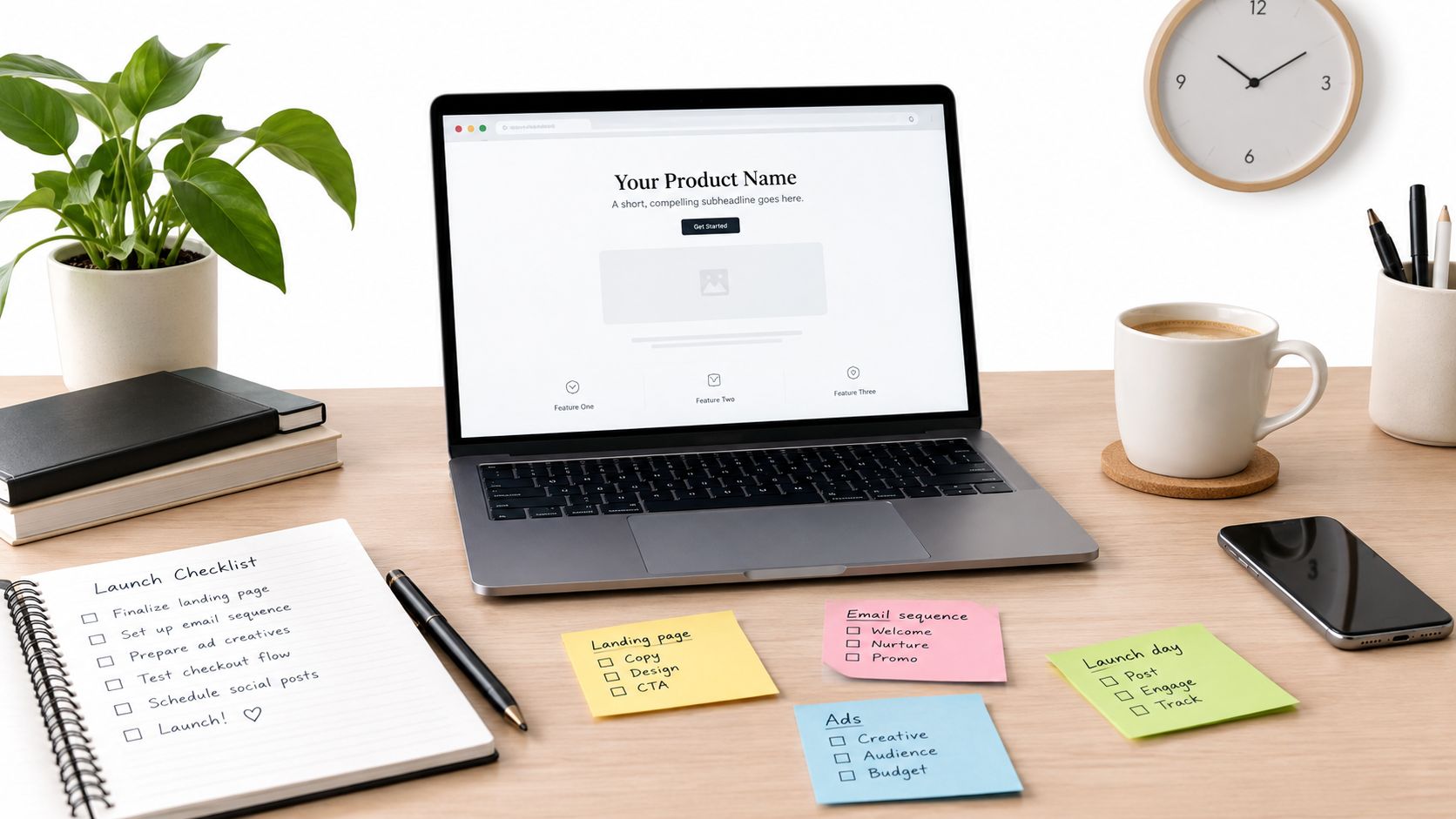
Keep the working setup focused on the complete buyer journey, not just production tasks.
Treat checkout as the middle
A closed-loop launch connects the promise you sell with the outcome learners reach. Plan for demand validation, delivery, participation, and feedback before you spend your energy polishing promotional assets.
The distinction matters because enrollment and completion aren't interchangeable. A peer-reviewed analysis of 221 MOOCs found completion rates ranging from 0.7% to 52.1%, with a median of 12.6%, and identified course length and assessment format among the factors associated with completion.
That isn't a forecast for your paid course. MOOCs include casual registrants whose commitment may differ from that of paying, instructor-supported learners. The useful lesson is to design for persistence rather than assuming enrollment will turn into participation.
Before launch, give each part of the journey an owner, even if you're that person:
- Demand: Confirm who needs the outcome and what makes the problem worth solving.
- Purchase: Make the offer, payment terms, and access instructions understandable.
- Participation: Decide what learners should do immediately and how you'll notice when they stall.
- Improvement: Collect evidence that helps you change the course, not merely sell it harder.
Practical rule: A launch isn't finished when someone buys. It's working when you can explain what happens after they buy.
Learning how to launch an online course without burning out means setting a smaller production scope and a clearer operating system. You don't need a full production team. You need a credible promise, a deliverable learning path, and a way to detect broken handoffs.
Validating the Idea Before You Record a Single Lesson
Start with the learner's unfinished task, not your subject area. A course about consulting is broad. A course that helps independent consultants turn an existing service into a clearly scoped proposal has a buyer, a practical deliverable, and a boundary.
Write your outcome as a sentence: This course helps [specific audience] produce [observable result] through [your method]. Avoid outcomes you can't control, such as guaranteed revenue or a job offer. Promise the capability or deliverable your teaching can credibly support.
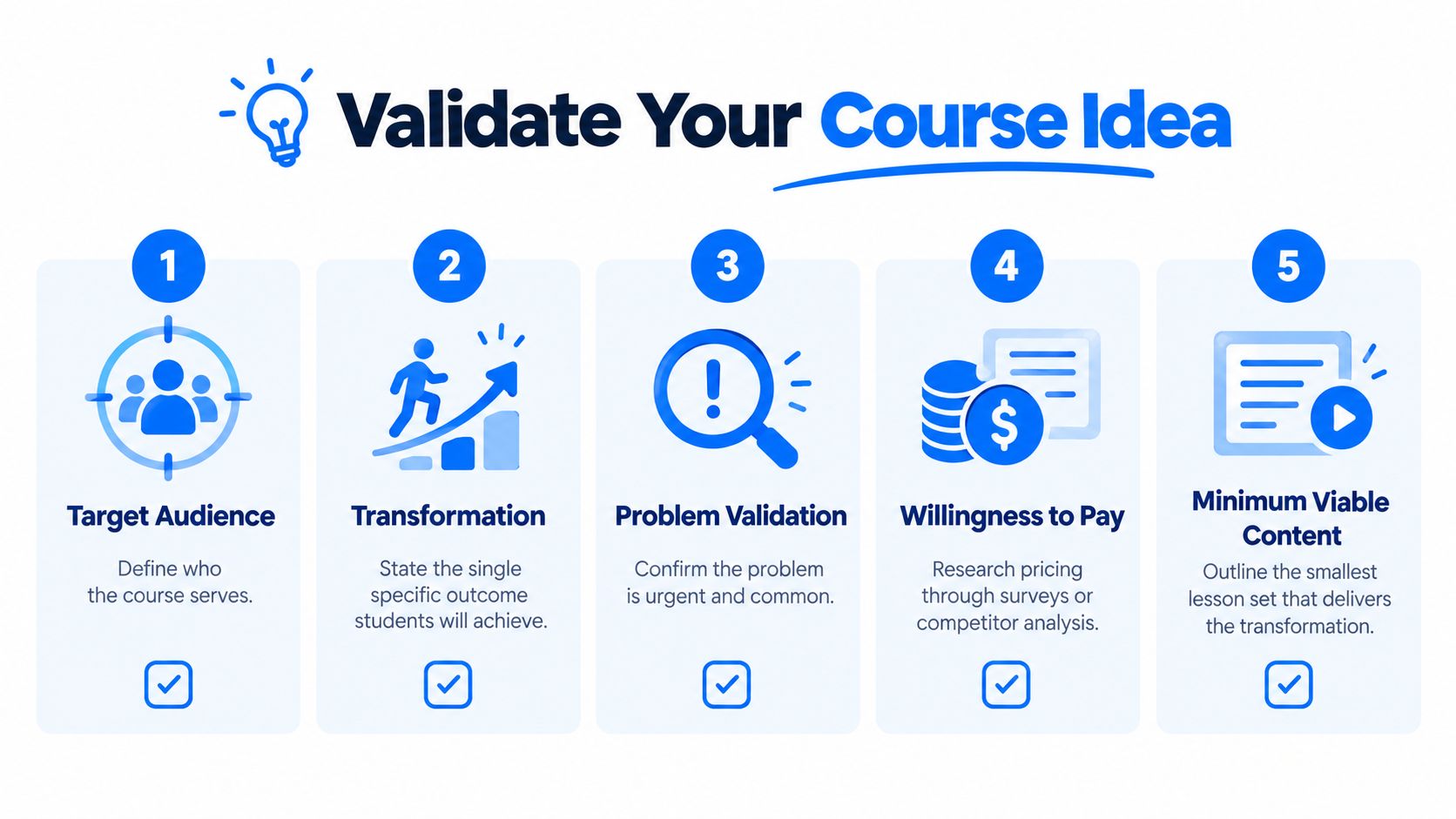
Use this checklist to separate a teachable idea from an attractive topic.
Look for behavior, not encouragement
Problem interviews should explore what prospects have already tried. Ask what happened the last time they attempted the task, where they got stuck, and what they used instead. Questions about past behavior are more useful for planning than asking whether your idea sounds interesting.
Someone who compliments the concept hasn't necessarily expressed purchase intent. A prospect who asks about prerequisites, delivery dates, or whether the course fits an active project gives you something more concrete to investigate.
| Signal | What it can tell you | What it doesn't prove |
|---|---|---|
| Waitlist signup | The promise attracts attention | The person will pay |
| Detailed problem interview | You understand a real obstacle | Your proposed format solves it |
| Paid pilot purchase | Someone accepts the offer and price | The course delivers its outcome |
A paid pilot lets you test the teaching before committing to polished recordings. Explain what's ready, what will be delivered live, when materials arrive, and what support is included. Don't sell an unfinished course as an instantly available library.
For a video perspective on course planning, use the resource below alongside your own buyer conversations.
Define the smallest credible product
Work backward from the final deliverable. Include the explanations, demonstrations, and exercises learners need to produce it. Move adjacent topics into a later-ideas document rather than adding them automatically.
Minimum viable doesn't mean incomplete. It means complete for a narrow promise. If learners need proposal scoping, a worked example, and a review checklist, those belong in the course. A history of consulting probably doesn't.
Proceed when you can name the buyer, describe the outcome, and identify a demand signal stronger than friendly encouragement. If you can't, revise the offer before recording. Editing a promise is cheaper in effort than rebuilding a curriculum around the wrong problem.
Designing Lessons Around Early Wins and Measurable Progress
Build lessons around what learners must do, not what you could explain. For the proposal course, an opening exercise might ask learners to describe a current client request and identify what's outside scope. That output gives them material they'll use throughout the course.
The reason to emphasize activity isn't just motivational. A study of approximately 646 learners across four online courses found that completers performed more than twice as many learning activities as non-completers, while ongoing assignments were significant predictors of completion.
Give each lesson a usable output
Use a repeatable lesson skeleton: state the objective, demonstrate the method, assign a task, and show learners how to check their work. Keep explanations short enough to support the task without burying it under background material.
The lesson-design visual below provides a practical sequencing checklist.
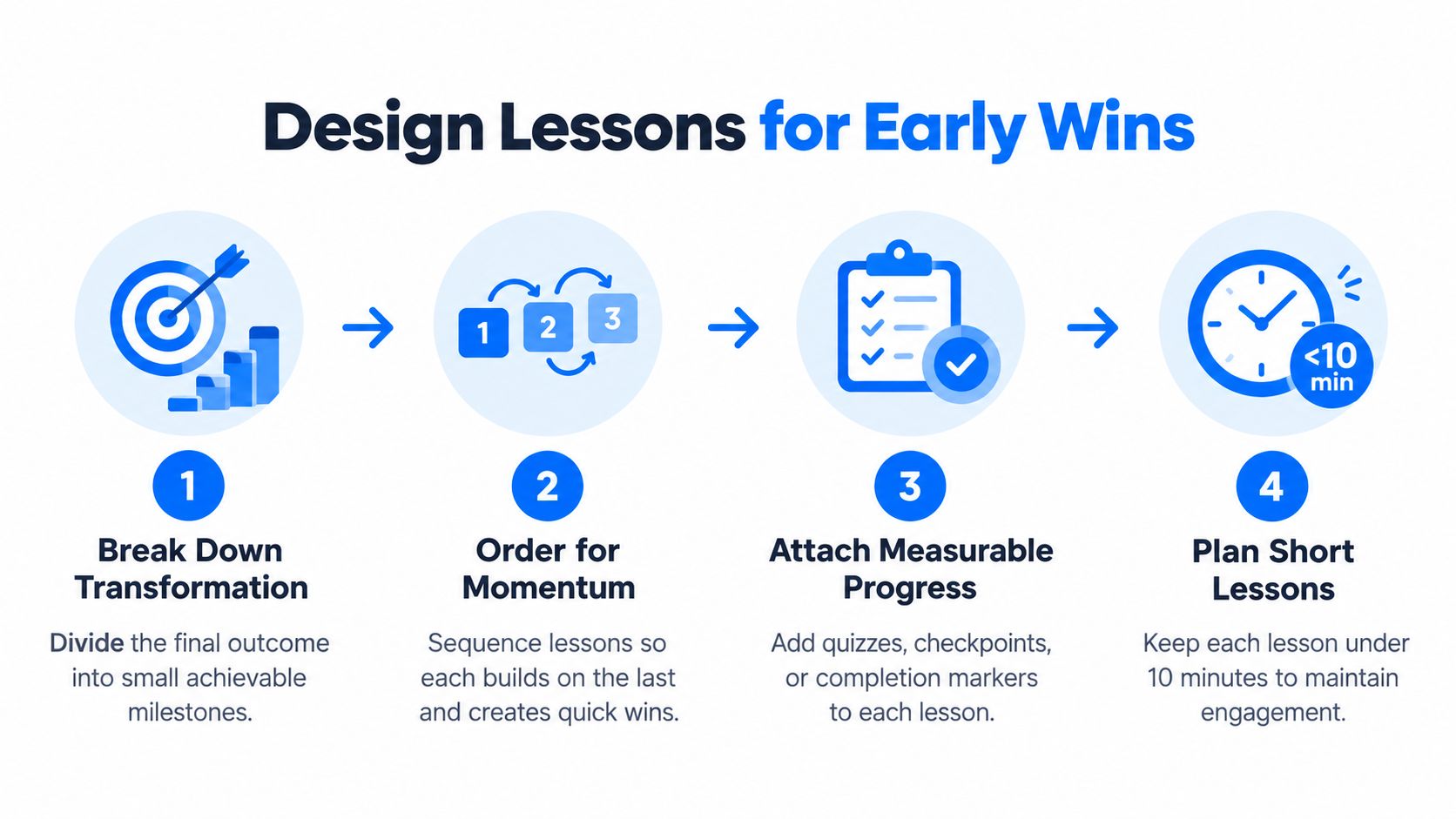
An assignment should have a visible finish line. “Reflect on your offer” leaves completion open to interpretation. “Draft the scope section using the supplied template” produces something learners can submit and evaluate.
Use quizzes for decisions with clear answers, such as recognizing an unsupported claim. Use submissions or implementation checkpoints for applied work. Automated assessment is convenient, but it shouldn't substitute for meaningful evaluation when judgment matters.
Map activation before choosing tools
Define the events you want to observe:
- Enrollment: The learner receives access and enters the course.
- First lesson started: They move beyond the welcome message.
- First assignment submitted: They produce evidence of action.
- Module completion: They finish a meaningful milestone.
- Final outcome: They demonstrate the promised result.
These events distinguish passive access from early activation. Decide what intervention belongs to each stalled stage, then check whether your tools can record the event directly or whether you'll need a submission form or manual review.
Use this digital-product tool selection guide to assess the workflow you need. Don't assume that a tool with sales analytics also measures assignments or learning outcomes.
Watching a video is evidence of exposure. Producing usable work is evidence you can evaluate.
Give learners a weekly workload estimate that includes exercises, not just video runtime. Test that estimate during the pilot and revise it if participants consistently need more time.
Polish the parts that affect comprehension first: audible narration, readable examples, accurate instructions, and accessible files. Elaborate transitions and branded introductions can wait. A shorter course still needs good teaching, but it doesn't need theatrical production.
Pricing the Course Without Guessing
Your production effort matters to your costs, but it isn't a persuasive explanation of value. Buyers aren't purchasing the evenings you spent editing. They're deciding whether your method, materials, and support justify the price for their situation.
Anchor your pricing decision to the outcome, available alternatives, and evidence of credibility. Review comparable offers to understand what buyers can choose, but don't copy a competitor's price without checking differences in audience, scope, and support.
Match the payment model to the promise
A one-time price is a straightforward fit for a defined course with a stable deliverable. A subscription needs an ongoing reason to remain enrolled, such as continuing instruction or regularly updated resources. Don't introduce recurring billing just because recurring revenue sounds appealing.
| Offer structure | Useful when | Trade-off to account for |
|---|---|---|
| Self-paced course | Learners can apply the method independently | Less individual feedback |
| Course with premium review | Expert feedback addresses a genuine obstacle | Your review capacity limits availability |
| Ongoing program | Buyers need continuing help | You take on continuing delivery obligations |
Keep the decision understandable. A premium track should add a distinct service, such as reviewing the learner's proposal, rather than withholding essential lessons from the base course.
Check the economics before committing
Use this planning formula without treating your assumptions as established facts:
Estimated retained revenue = qualified reachable audience × assumed purchase rate × price, minus expected refunds.
Then subtract payment costs, platform expenses, delivery costs, and the value of your support time. If you have no purchase history, label conversion and refund assumptions as uncertain and examine conservative scenarios. Don't borrow a generic conversion benchmark to make the plan look viable.
A pilot can help you evaluate price alongside workload. Track why people decline, what purchasers expect, and how much assistance they require. A sale at a particular price doesn't establish that your support model is sustainable.
- Founding-member rate: Make the reduced price reflect pilot participation and feedback.
- Payment plan: Use it only if your checkout supports the arrangement and you can explain the total commitment.
- Launch discount: Tie it to a genuine condition or deadline, not an invented countdown.
Your sales-page justification should describe what buyers receive and why it helps. Underpricing out of fear doesn't resolve a vague promise, and a premium price doesn't create proof you haven't earned.
Building the Sales Page, Email Sequence, and Checkout Flow
Draft the sales page from the validated promise and actual curriculum. State who the course serves, what learners will produce, the prerequisites, the expected workload, and the support boundaries. Show a sample exercise or worked example when you don't yet have learner testimonials.
Don't fill the proof gap with fictional success stories. A clear demonstration of your method is more honest than implying results you haven't documented.
Connect the offer to fulfillment
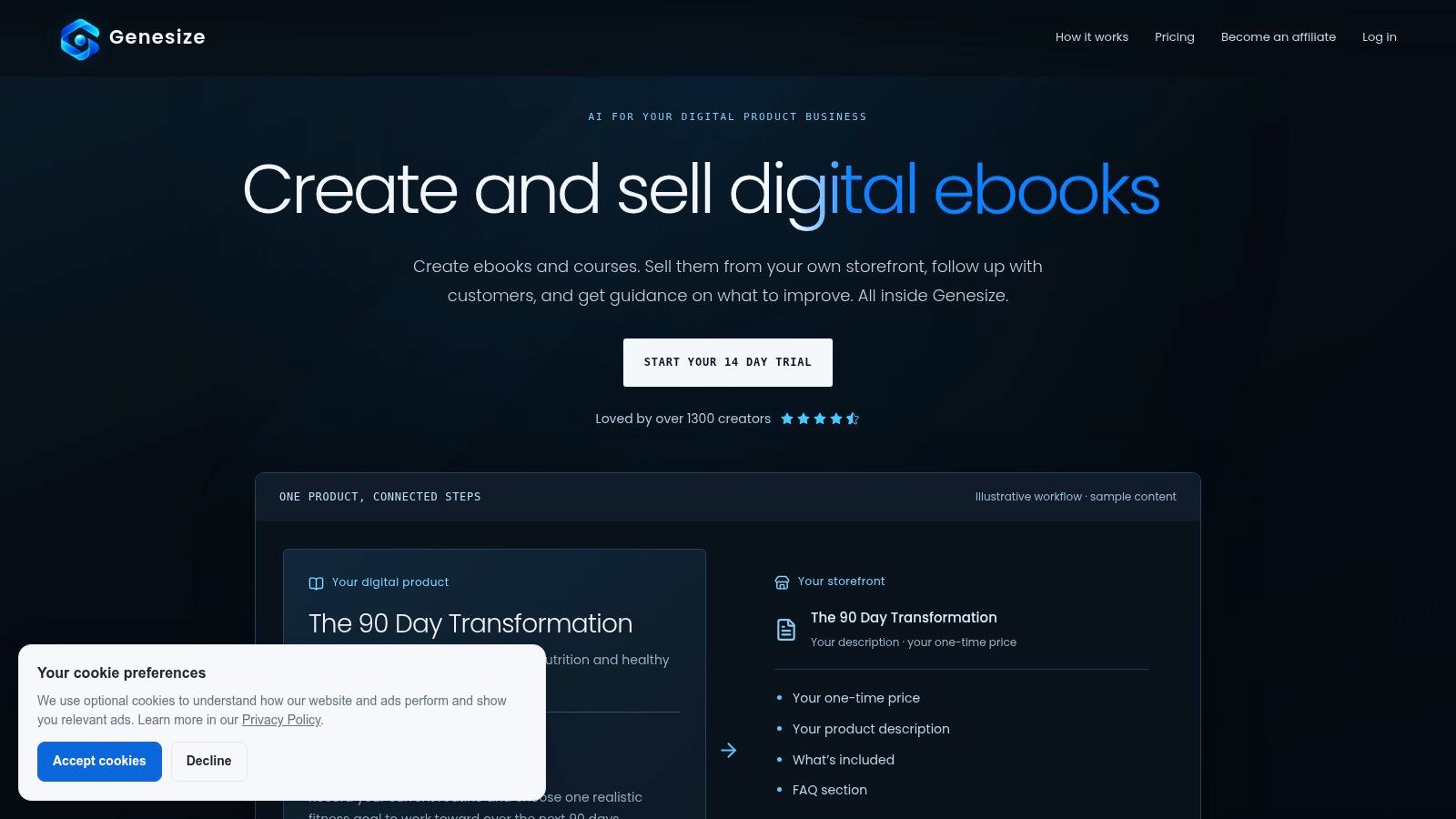
You can use a dedicated course platform, a hosted digital-product storefront, or a modular setup with separate delivery tools. Genesize is one option that combines AI-assisted product creation, sales-page drafting, a hosted storefront, Stripe checkout, email tools, CRM, and buyer delivery management.
The screenshot below shows its public landing page.
Choose based on the delivery model, not the longest feature list. Confirm where lessons live, how buyers retrieve resources, and how you'll collect assignments. An integrated workspace reduces handoffs, while separate tools can offer specialized teaching features at the cost of more setup.
For downloadable workbooks accompanying the course, the guide to selling ebooks online provides a related product-packaging workflow. Keep course access and supporting downloads clearly labeled.
Make email readiness a launch requirement
Before announcing enrollment, verify sending-domain authentication through SPF, DKIM, and DMARC, confirm permission-based contacts, and use a recognizable sender identity. Test unsubscribe handling and suppress hard bounces. Don't import an unverified list or begin sending at full volume from an untested domain.
The 2025 global email deliverability benchmark reported that roughly one in six legitimate marketing emails failed to reach the inbox. A well-written sequence can't compensate for messages buyers never receive.
Organize the campaign around the decision buyers need to make:
- Problem and outcome validation: Describe the task and invite relevant replies.
- Curriculum preview: Demonstrate how the teaching addresses it.
- Enrollment opening: Present the offer, price, and access details.
- Objection handling: Address prerequisites, workload, fit, and support.
- Deadline or onboarding: Communicate a real closing condition, or direct purchasers into learning.
Tag contacts by source, intent, purchase status, and engagement. Purchasers should leave the sales sequence; interested non-buyers should receive relevant follow-up rather than identical broadcasts.
Test the entire path on desktop and phone: email link, sales page, checkout, confirmation, access, and resource retrieval. Check failed-payment and access-recovery instructions too. Judge the funnel through delivered messages, clicks, checkout starts, purchases, and refunds, not opens alone.
Delivering the Course and Tracking What Actually Matters
After payment, the learner should know where to go, what to do first, and how to get help. Send a welcome message that links directly to the starting point rather than presenting every resource at once. Keep account recovery and support instructions easy to find.
Store purchase status and buyer records in your CRM, but distinguish those records from learning activity. A payment tag confirms a transaction. It doesn't confirm that the learner opened the course or completed an exercise.
Make access resilient
Offer captions, transcripts, readable documents, and downloadable alternatives where appropriate. Check whether someone can complete the core task from a phone or with interrupted connectivity. Provide a recovery route when payment succeeds but access fails.
The institutional context is different from a creator business, but the 2025 CHLOE report found that 88% of surveyed institutions said the digital divide affected at least some online students, while 37% considered themselves fully prepared to meet those needs. Don't assume your paying customers all have uninterrupted broadband or equal technical confidence.
Read the dashboard as a diagnosis
Build your completion view around the activation events already defined. Keep the denominator visible whenever you report a completion rate, and separate missing evidence from confirmed non-completion.
| Learner pattern | What to investigate | Appropriate response |
|---|---|---|
| Paid but never started | Access failure or unclear orientation | Send a direct start link and offer access help |
| Started but submitted nothing | Confusing task or excessive scope | Clarify the assignment and provide an example |
| Submitted work but stalled | Missing prerequisite or feedback | Review the obstacle before sending reminders |
| Reached the outcome | Which parts were useful | Request specific feedback and permission to share results |
Send milestone messages based on demonstrated progress, not just elapsed time. A learner struggling with an assignment needs different help from someone who couldn't log in.
When comparing systems, use the all-in-one digital-product platform guide to examine how purchase records, email segments, and delivery connect. Verify learning-event support separately.
Growth Agent-style recommendations can suggest whom to contact next using account activity. Treat them as prompts to investigate, not proof of learner intent. Your post-launch job is to connect observed friction with a specific correction.
Turning Your First Launch Into a Learning Loop
The first launch should produce decisions, not just a revenue total. Review which prospects understood the offer, where buyers encountered friction, and what learners produced. Change the part responsible for the problem rather than rebuilding everything.
Low raw completion doesn't automatically establish failure. Someone may have achieved the useful result without watching optional material, while another buyer may never have entered the course. Investigate the difference before concluding that you need more videos or more reminders.
Launch discipline: Fix the clearest obstacle before adding another feature.
Set a launch window you can sustain
Use the next month as a working shipping window, not a reason to rush an unvalidated promise. Keep the checklist tied to decisions:
- Validate: Interview intended buyers, refine the outcome, and invite qualified prospects into a clearly described pilot.
- Design: Build the essential learning path and test the opening assignment.
- Price: Choose an understandable offer and check whether delivery effort makes it sustainable.
- Connect: Publish the storefront, prepare permission-based email, and test payment through access.
- Follow up: Review learner work, investigate stalled stages, and record the changes worth making next.
Protect time for supporting the pilot instead of filling the calendar with promotional production. If learners can't complete an essential task, improve that task before expanding your reach.
A sprawling unfinished library gives you more to maintain and less evidence about what matters. A focused course gives you a bounded promise to test. Ship that promise, observe the result, and use what you learn to make the next launch more deliberate.
Genesize brings course creation, a hosted storefront, Stripe checkout, email follow-up, and buyer records into a single workspace. Visit Genesize to turn your validated course outline into a focused offer and connect the purchase-to-delivery workflow before inviting your pilot learners.