Selling Courses Online in 2026: Steps to Your First Sale
A step-by-step guide to selling courses online in 2026: choose an outcome, price it, set up checkout and delivery, and launch with email.

You've got notes, client worksheets, and a subject people keep asking you about. You may even have a course outline, but every time you open it, you add another lesson instead of putting an offer in front of buyers. The difficult part isn't finding more material. It's deciding what someone should pay to achieve, and how you'll help them finish.
Selling courses online starts with a finishable promise. Your price, delivery format, and welcome email should all support that promise. A first sale validates someone's willingness to pay; a completed student project gives you something stronger to build the next launch around.
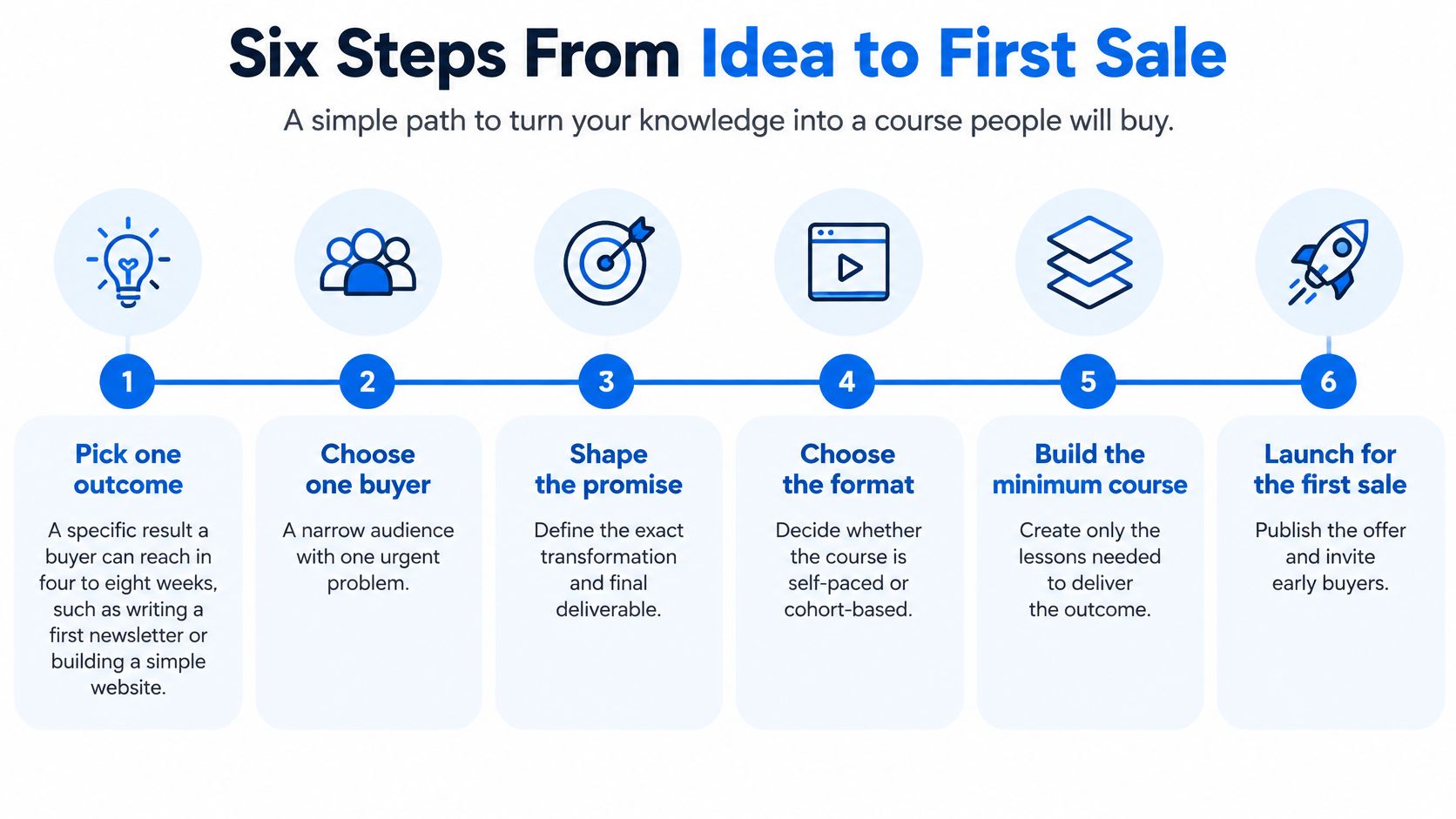
Six Steps From Idea to First Sale
Pick an outcome and a buyer. Choose a result you can assess, such as publishing a newsletter, rather than a topic such as content marketing. Identify who needs it and what they already know. Give this an initial planning session, then move on when you can describe the buyer, deliverable, and prerequisites without listing your curriculum.
Check paid demand. Ask past clients, students, or relevant followers what they've tried, what they've paid for, and why they're still stuck. Reserve a discovery phase before production. You're ready to proceed when people take a meaningful action, such as joining a focused waitlist or purchasing a clearly described pilot, not merely liking an announcement. Use this guide to validate a digital product idea before you build it to structure that decision.
Map the work backward. Start with the finished project and identify the decisions and skills required to produce it. During your outlining block, group those tasks into modules with a deliverable at each stopping point. The outline is ready when every lesson supports an observable action.
Build the minimum teachable course. Record screen demonstrations, write explanations, and create worksheets only where they help the student act. Schedule separate production and review blocks around your available evenings. Stop adding material when a suitable beginner can follow the instructions and produce the promised work.
Connect the buying path. Prepare the sales page, payment, access, and welcome message as a single workflow. Reserve a dedicated testing session rather than squeezing it into launch day. This stage is done when a buyer can complete the journey without your intervention.
Invite early buyers. Open the waitlist while you're finishing production, then announce a defined enrollment window. Set the actual dates around your readiness and support capacity. Move from selling to delivery when buyers have access and know their first action.
Put the calendar behind the deliverables
Treat these as planning blocks, not industry-average timelines. If discovery produces no buying intent, extend discovery rather than recording lessons to stay on schedule.
The visual summarizes the decisions behind the route.
Don't skip the test purchase. A polished sales page won't compensate for a buyer who pays and can't open the course.
Price the Course With the Right Model
Pricing models and when each fits
| Model | Best for | How revenue arrives | Main risk |
|---|---|---|---|
| One-time payment | A single, clearly defined outcome | One payment at purchase | Buyers hesitate at higher prices |
| Payment plan | A higher-priced, longer program | A disclosed schedule of installments | Buyers stop paying before the final installment |
| Membership | An ongoing library or community | Recurring monthly or yearly charge | You must keep adding material to justify renewals |
| Cohort seats | Programs built on live feedback | Fixed price per seat, limited places | Small audience per launch limits revenue |
Price the outcome and support, not the lesson count. Package the smallest curriculum that can deliver the result, then compare it with the buyer's practical alternatives: hiring a coach, taking another course, or continuing to make the mistake your course addresses.
Say you're teaching freelance designers to prepare client proposals. Buyers aren't evaluating your recording hours. They're evaluating whether your process helps them scope work, explain fees, and send a proposal they can defend.
Match the payment to the commitment
A one-time payment works well when the purchase has a clear finish line. State what's included, how long access lasts, and whether feedback is part of the offer. Don't imply ongoing personal support if you're selling a reference resource.
A payment plan can reduce the initial cash commitment, but it doesn't reduce your delivery obligation. Publish the total payable, payment dates, and consequences of failed payments. Don't budget as though every future installment is already cash in the bank.
A membership needs a continuing reason to renew. That could be maintained resources, relevant updates, or facilitated participation. If you have a finite method to teach, a subscription may create unnecessary production work after students have achieved their goal.
For cohort seats, calculate the time you'll spend reviewing submissions, preparing sessions, and answering questions. Set capacity from that workload before estimating launch revenue. Otherwise, a successful launch can leave you unable to provide the feedback you sold.
Give buyers evidence before asking for more
A higher price needs visible support: a sample lesson, a useful preview of the final deliverable, permission-based student work, and clear refund terms. A refund policy explains risk; it isn't proof that the teaching works.
Put the actual price on your draft sales page and ask prospective buyers what would prevent them from purchasing. Separate affordability objections from credibility objections. Installments may address cash flow, but they won't repair an unclear promise.
For international sales, check supported currencies and payment methods before publishing a universal offer. Consider a reduced-support tier where appropriate, but preserve the materials students need to achieve the advertised outcome.
Choose Cohort or Self-Paced Delivery
Reported completion by course format
| Format | Reported completion | Best fit | Trade-off |
|---|---|---|---|
| Scheduled cohort | 53.4% | Premium programs with practice or accountability | Fixed dates exclude buyers who want to start anytime |
| On-demand | 42.9% | Courses with milestones but a flexible start | Less shared pace between buyers |
| Open-access self-paced | 41.9% | Reference-heavy products and lookup material | Lowest reported completion in this comparison, so onboarding needs attention |
The 53.4%, 42.9%, and 41.9% completion figures come from platform-level comparisons summarized by Ruzuku's online-course statistics, and they're observational benchmarks, not proof that changing format causes better completion. Different audiences, commitments, and course designs can affect the comparison.
Use the format comparison to think about the experience you're selling.
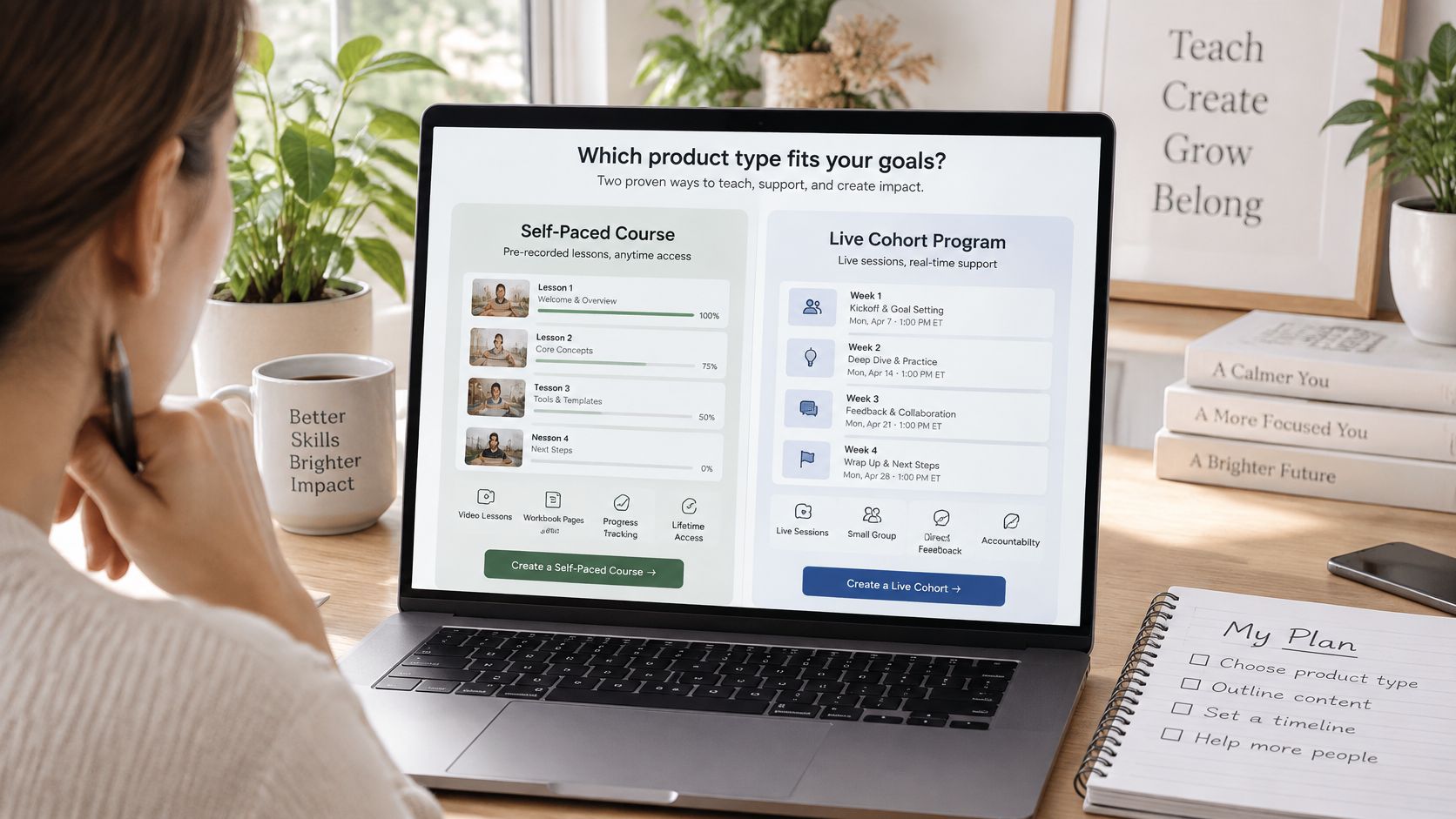
Choose around the student's work
A software lookup course or template library suits self-paced access. Buyers may need a specific answer rather than a start-to-finish journey. Make navigation, search-friendly lesson names, and downloadable reference material priorities.
A course that requires practice, judgment, or uncomfortable action benefits from scheduled accountability. Proposal writing, presentation delivery, and portfolio development all involve producing something that another person can review.
For a cohort, sell a fixed start date and cap enrollment at a workload you can support personally. Publish weekly milestones and require a visible action, such as a submission or check-in. Follow up about the missed action specifically, rather than sending a vague reminder to keep learning.
The video below offers another resource to review while considering delivery.
Use a pilot to identify what needs feedback
A useful hybrid is a capped pilot cohort followed by an edited on-demand product. Record demonstrations with permission, remove participant-specific information, and replace meandering session recordings with focused lessons.
Keep live support where students need judgment, not where they merely need instructions. When comparing Kajabi alternatives, assess those requirements explicitly: scheduled delivery, submission handling, discussion, and buyer access aren't interchangeable features.
Choose a format you can deliver consistently. Don't promise personal review unless you've reserved the time to provide it.
Set Up Checkout and Delivery for Early Activation
Activation means a buyer starts doing the work, not just receiving a login. A peer-reviewed analysis of 221 MOOCs indexed by ERIC reported a median completion rate of 12.6%, but open-course enrollment includes low-intent participants, so that isn't an appropriate target for a paid specialist course.
Use completion evidence to ask better operational questions, not to excuse disengagement.
Build the path in purchase order
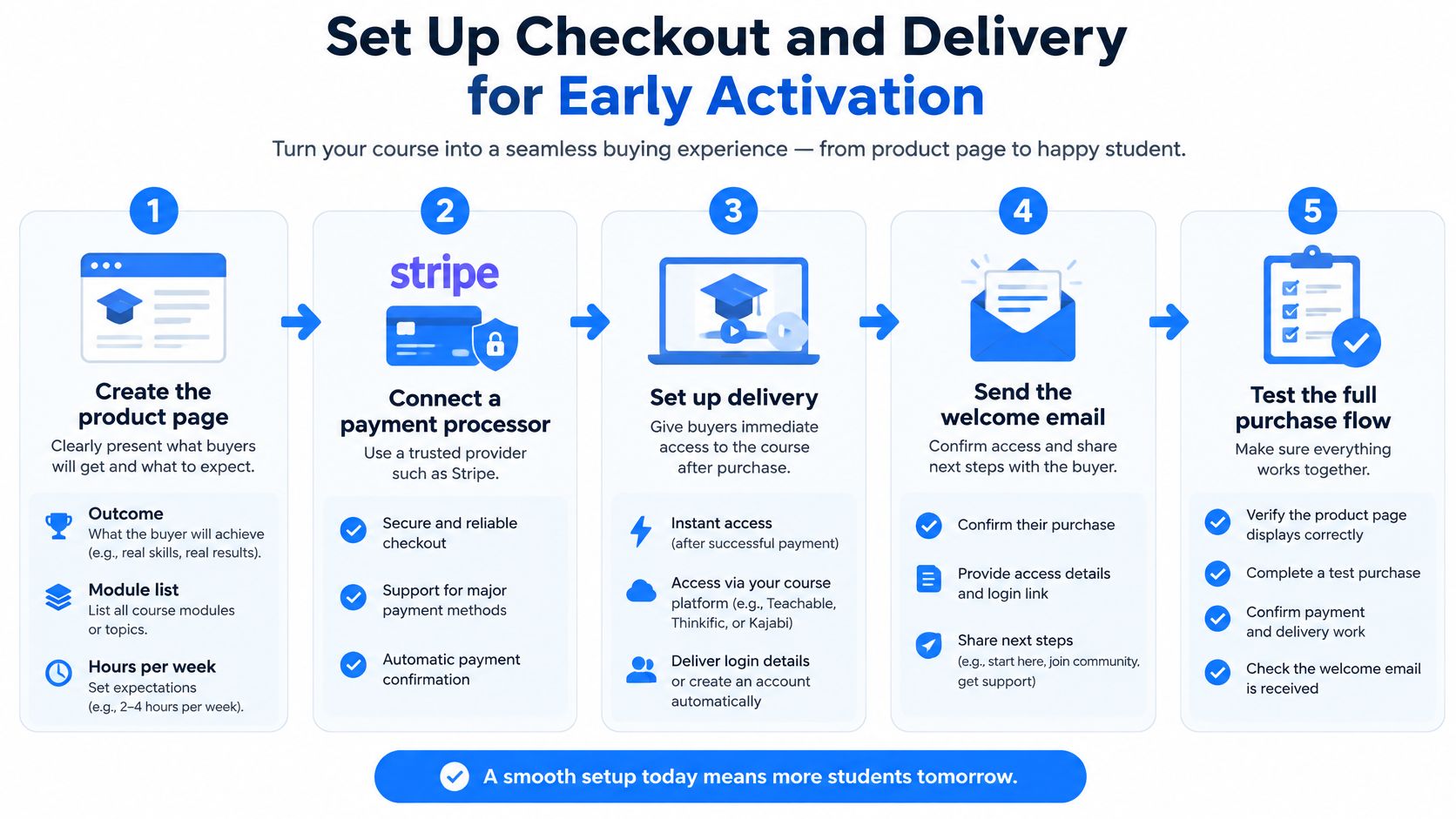
Create the product page. State the outcome, prerequisites, module deliverables, expected workload, access terms, and support boundaries. Estimate workload by completing the exercises yourself, allowing for a beginner's slower pace. Buyers need to understand the commitment before paying.
Connect payment and clarify terms. Use a processor such as Stripe and inspect the checkout from the buyer's perspective. Show refund terms before purchase, and confirm your regional tax and consumer obligations. At Genesize, customers remain responsible for their products, customer contracts, refund terms, taxes, accessibility, and fulfillment.
Configure immediate access. Connect successful payment to the correct login, private course, or download. Test using a buyer identity rather than an administrator session, because existing permissions can hide access problems. Check the receipt, password setup, resource links, and route back into the course.
Put useful work at the entrance. Make the opening assignment small enough to attempt immediately. For a newsletter course, that might be drafting the reader promise rather than watching an extended introduction. Provide an example and explain what a satisfactory submission looks like.
Send a focused welcome email. Confirm access, identify the first task, and link directly to it. Keep receipts and account details available without letting administrative content obscure the learning action. Send a targeted follow-up when the buyer hasn't begun.
Track the stages separately. Record checkout conversion, first-lesson starts, progression, and completion as distinct measures. Define completion in terms of the promised work where possible, rather than treating a manually checked lesson as evidence of mastery.
This setup flow makes the purchase-to-learning handoff visible.
Remove access barriers before chasing motivation
In a 2025 study of four MOOCs published in JMIR, 31% of learners in low-income countries said the content was accessible to people in their country, compared with 78% in high-income countries. That finding concerns perceived accessibility, not a direct measure of your prospective buyers' connections or budgets.
Test on a phone and a slow connection. Provide captions, transcripts, readable downloads, and examples that don't assume a particular country's business practices.
If buyers start but stall at the same assignment, inspect its instructions and difficulty before adding reminders. If they never start, investigate access, welcome messaging, and buyer fit.
Activation reading rule: Strong first-lesson participation means the entry path is working, not that the full course has proved its effectiveness.
Build a Waitlist and Launch Email Sequence
A useful waitlist lets prospective buyers try your teaching before you ask for a purchase. Offer a worksheet, sample lesson, or checklist taken from the actual course. An unrelated giveaway can attract subscribers who have no reason to buy the paid outcome.
Build the list during production, but don't announce an enrollment deadline until you can fulfill the offer. A launch date should create a manageable delivery commitment, not pressure you into selling unfinished promises.
Give each message a job
Establish relevance before presenting the course. Send an email describing the buyer's problem in concrete terms. For a proposal-writing course, explain how unclear scope creates revision disputes. Ask readers where their current process breaks down.
Demonstrate the teaching. Send the sample lesson and a task they can complete with it. Explain what they should produce and how to judge it. This gives subscribers a reason to trust your method beyond your biography.
Make the buying decision clear. Announce the opening date, delivery format, support, price, and genuine deadline. If enrollment closes because a cohort begins, say so. Don't invent scarcity for a product that remains continuously available.
Open enrollment with the complete offer. Link to the sales page and explain who should enroll, who shouldn't, and what students need before starting. Include credible evidence where available, without presenting an exceptional result as a typical promise.
Address hesitation during the enrollment window. Use questions from replies to clarify workload, prerequisites, access, and feedback. In the closing message, state the deadline and its practical consequence. Remove buyers from promotional reminders and move them into onboarding.
Support the sequence without overwhelming yourself
Choose an outside channel that reaches people with the relevant problem: a partner newsletter, a guest article, or a live workshop. Match the invitation to the same outcome as the waitlist resource. Don't split your attention across channels you can't monitor.
If you have pilot results, describe what participants produced and the context in which they produced it. Get permission before sharing their names, work, or feedback. Without student evidence, demonstrate the method plainly rather than manufacturing social proof.
Use an email list people joined willingly, include an unsubscribe option, and test messages in your own inbox. Don't buy a list or assume that having someone's address means they agreed to promotional emails.
Watch waitlist-to-buyer conversion alongside actual replies. If subscribers engage with the sample but don't purchase, examine the offer, timing, and price objections. If they don't engage with the sample, investigate audience fit before increasing promotion.
Decide Your Platform Fit and Next Move
A single workspace fits best when your main obstacle is moving between drafts, sales pages, checkout, buyer access, and follow-up. Genesize turns your expertise into ebooks, courses, and practical resources, with an editable draft, hosted storefront, Stripe checkout, and buyer delivery. You can build the sales page and check the buying steps while the product remains private.
Choose software around the offer you're ready to deliver. For a straightforward written course with a one-time purchase, integration can reduce the handoffs you must manage. If your offer requires live assessment or specialized learning tools, evaluate those requirements separately rather than assuming every selling platform provides them.
Keep the commercial boundaries clear
Your course and its customer commitments remain your responsibility. Genesize takes no cut of product sales; the subscription covers the software, while Stripe payment fees are separate. You still need to manage appropriate terms, refunds, taxes, accessibility, and fulfillment.
The broader decisions involved in selling digital products matter, but they shouldn't become a reason to postpone a usable offer. Software can support delivery; it can't guarantee that the right buyer completes the work.
Set a practical scope test: by the end of your working week, aim to complete the buying journey and the opening lesson yourself. If either remains tangled, reduce the course until both work. Pick your first outcome and start drafting the module that helps a buyer achieve it today.
Genesize helps you turn your expertise into an editable course, build its sales page, and connect payment with buyer access. Visit Genesize to draft your first outcome-focused module and check the purchase path before inviting early buyers.