How to Turn Existing Content Into Digital Products with AI
How to Turn Existing Content into Digital Products with AI: pick the right material, build a module outline, and write course titles, outcomes and buyer copy.

Turning your most popular post into a course is often the wrong starting point. People can enjoy your advice without wanting to pay for more of it. A paid product needs something stronger than attention: a problem buyers want resolved and a credible path to resolving it.
Learning how to turn existing content into digital products with AI starts with that distinction. Use AI to organize your material, draft lessons, and adapt explanations. Keep the product decisions and factual responsibility with the expert, because faster production won't rescue an offer nobody needs.
Choose Which Content Becomes a Product
Your most-viewed content may build trust without revealing willingness to pay. Look instead for questions about expensive mistakes, unfinished tasks, and processes people keep attempting unsuccessfully.
The IAB's creator-economy research projected that U.S. creator advertising spending would reach $37 billion in 2025, but advertising demand isn't evidence that your audience wants a paid workbook. Buyers need a reason to purchase beyond liking your content.
Source material and the first product format it fits
| Source material | First product format | Demand signal to check | Keep free or paid |
|---|---|---|---|
| Recurring questions from email or DMs | Mini-guide or FAQ workbook | Asked by several people who don't know each other | Answer the simplest question free |
| Client delivery notes and templates | Toolkit or template pack | Clients ask for the same deliverable again | Paid |
| Webinar or video transcripts | Self-paced course | Viewers finish but still ask how to apply it | Keep the overview free |
| Blog posts on one unresolved problem | Four to seven chapter ebook | Readers want step-by-step detail beyond the free post | Paid |
| Popular inspirational posts | Lead magnet only | No specific problem behind the engagement | Free |
Test the problem before the format
Group your source material by audience problem, not publication channel. In a spreadsheet, record who asked about each problem, what they've already tried, and what remains unresolved. Count separate people, rather than repeated messages from an enthusiastic follower.
Say a bookkeeping coach reviews a large archive and discovers that only a small cluster addresses late invoice payments. Those posts aren't the most popular, but readers keep asking for reminder scripts, payment-term examples, and an escalation process. That's a stronger product foundation than general motivation for business owners.
Use these digital product ideas to compare delivery formats after identifying the problem. Then choose one cluster and one outcome. Offer a clearly described paid pilot or preorder, with honest delivery and refund terms, before producing the full product.
How to Build a Module Outline from Your Sources
Treat the model as a drafting and classification layer, not your subject-matter authority. Give it approved material and a specific transformation instead of asking it to invent a complete course about your field.
Start by making the source collection usable.
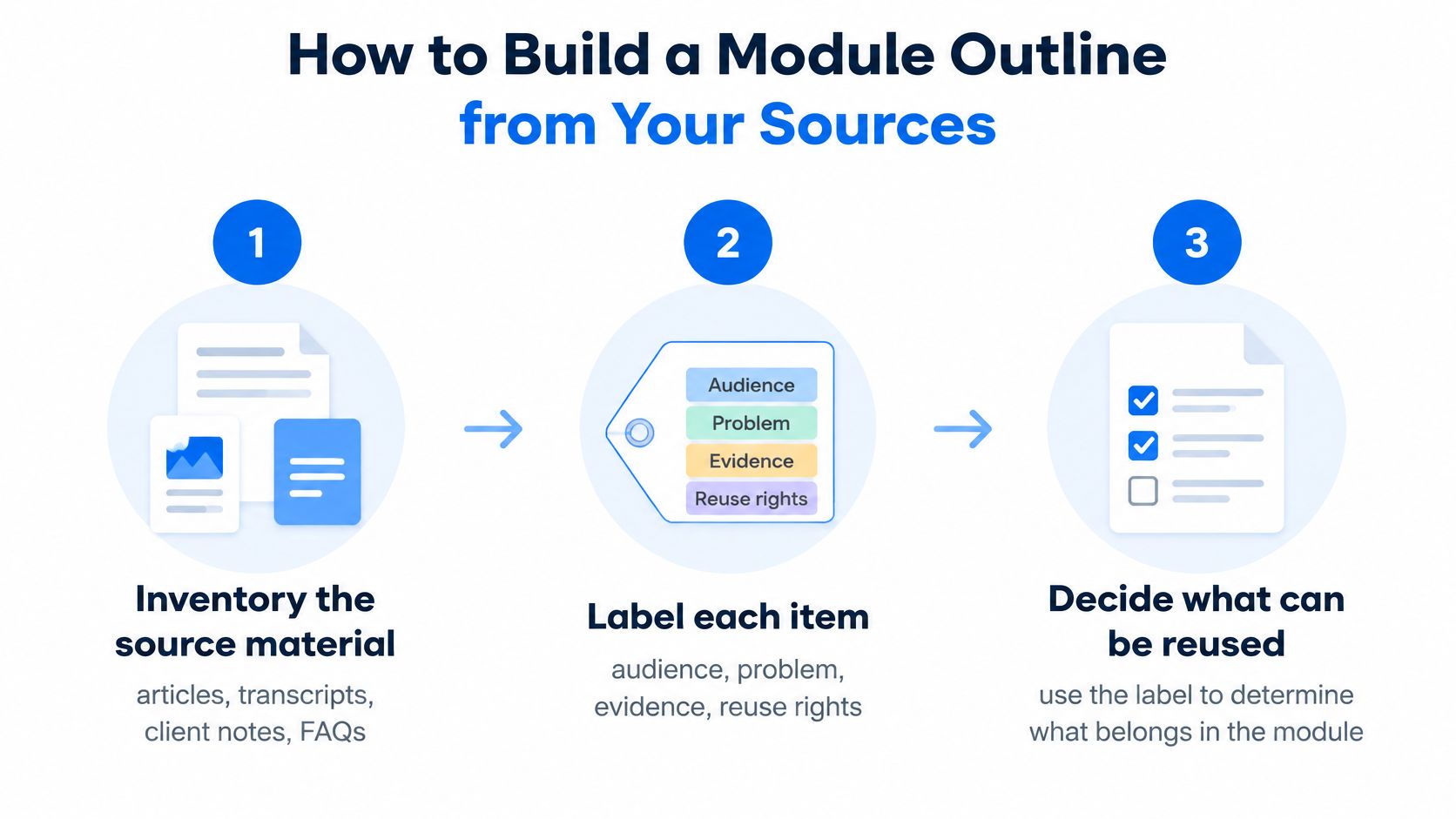
Inventory and label your sources. Gather articles, transcripts, presentations, client notes, and FAQs. Label each item by audience, problem, evidence, and reuse rights. A useful client document isn't automatically suitable for publication, and introductory advice doesn't belong in an advanced module just because it's available.
Require passage-level mapping. Ask the AI to attach a source filename and passage reference to every proposed chapter, lesson, or worksheet. Keep a traceability table containing the proposed module, supporting passage, exercise, and unresolved gap. Unsupported additions should appear as questions for you, not finished instruction.
Define the transformation and sequence. For example, a consultant might promise to help buyers produce a client-ready audit. Build a manageable milestone sequence from prerequisites to application, rather than following the order in which the original posts were published.
Give every milestone an output. Include a short explanation, worked example, action step, and measurable artifact. A concept becomes a lesson; a process becomes a checklist; a case study becomes a diagnostic exercise; recurring questions become supporting FAQs.
Give the AI a bounded assignment
A useful prompt specifies the audience, approved sources, promised result, and output structure. Add instructions to preserve source references, identify missing prerequisites, and flag uncertainty rather than filling gaps with plausible detail.
Practical rule: If a proposed module has no source support and no learner deliverable, it isn't ready for the outline.
Speed doesn't eliminate review. A 2024 comparative study published in JMIR AI judged 18 of 21 extracted factors, or 86%, accurate, while human reviewers performed better on contextual understanding, transparency, and accuracy.
Don't turn every paragraph into a lesson. That produces an archive with navigation, not a learning product. Before accepting the outline, check whether each module can be completed in a sitting and whether its artifact moves the buyer toward the promised result. Verify facts and claims before layout.
Write Course Titles, Outcomes and Descriptions
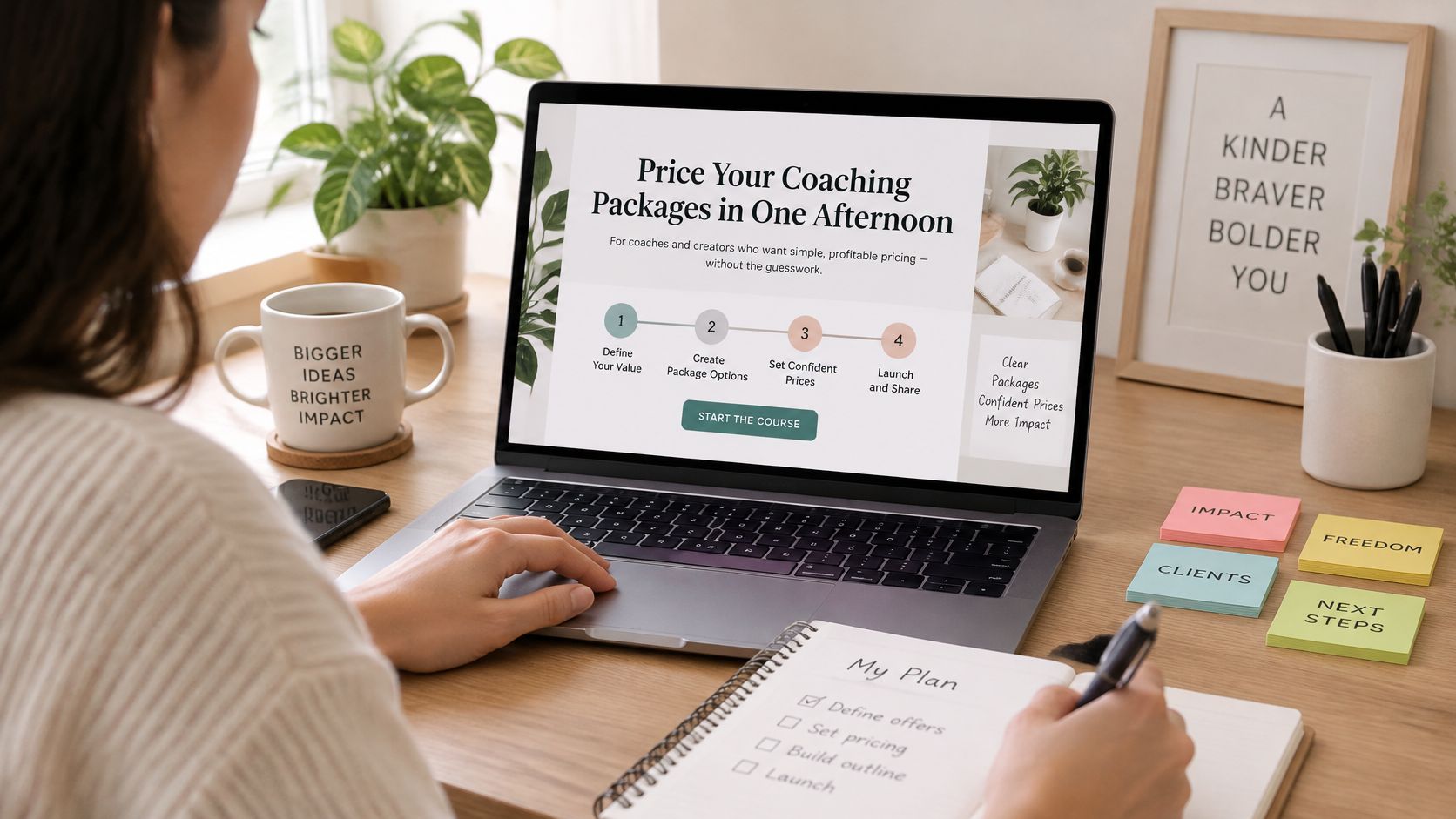
Build the title from the outcome, audience, and a credible timeframe. A vague working title such as Coaching Business Essentials becomes more useful as Price Your Coaching Packages in One Afternoon. The rewrite names a task buyers can picture finishing.
Only include a timeframe when the work fits it, including prerequisites. If buyers need an established service offer before starting, say so rather than implying that beginners can complete the entire business setup.
The course page should make the practical task visible before buyers inspect the curriculum.
Write the result before the description
A learning outcome needs an action and an artifact, not a topic label. Marketing Basics describes subject matter. Write a reusable content plan describes something the buyer will produce. That distinction also tells you what the product must include.
Use AI to generate alternative wording, then reject versions that enlarge the promise. Words such as master, guaranteed, and effortless often conceal a result you haven't designed the instruction to deliver.
Copy elements for a course or ebook page
| Element | Formula | Example | Check before publishing |
|---|---|---|---|
| Course title | Outcome, audience, timeframe | Price Your Coaching Packages in One Afternoon | Can a buyer picture the result? |
| Subtitle | Who it's for and the obstacle | For coaches who have the method but no product yet | Does it name one obstacle, not several? |
| Learning outcome | By the end, you can [action] using [artifact] | By the end, you can price a coaching package using a one-page rate sheet | Is the artifact included in the product? |
| Module title | Verb plus concrete task | Map your recurring client questions to chapters | Can the task be finished in one sitting? |
| Description opening | Problem in buyer words, then what changes | Your inbox keeps filling with the same questions. Build a guide you can send instead of rewriting each answer. | Does the first line match the title? |
| Audience line | Who it's for and who it's not for | Built for solo consultants, not agencies with teams | Does a buyer outside the target know to skip? |
Treat these as separate examples, not copy to assemble unchanged. A pricing title and an inbox-management description don't belong on the same sales page.
Use the video as a supplementary resource, not a substitute for explaining your own deliverable.
If a buyer can't picture finishing the product after reading the title and first outcome, rewrite both before designing the cover.
Write Copy That Speaks to the Right Buyer
For anyone who wants to grow their business is too broad to help someone decide. For consultants who keep spending their weekends rewriting the same proposal identifies a recognisable situation and suggests a useful deliverable.
Start with language buyers already use in emails, support questions, comments, and recordings. Collect a small set of exact phrases in a private voice-of-customer document. Use that language faithfully, but remove identifying details and don't publish private messages without permission.
Describe the attempt that failed
Explain what the buyer currently does, where they get stuck, and what the repeated effort costs them. A proposal toolkit becomes more credible when you explain that it helps buyers adapt a reusable scope and pricing structure, rather than promising vague business growth.
- Name a situation. Address the consultant rebuilding proposals from scratch, not everyone who owns a business.
- Set a boundary. Explain that templates won't choose their positioning or replace legal review of their contract.
- Answer the main objection. If buyers worry that templates sound generic, explain which sections they customise and show a completed example in the body copy.
Buyers shouldn't have to translate your product description into their own working day.
Ask AI to compare the audience line, title, and first outcome for contradictions. A page aimed at established consultants shouldn't suddenly promise beginners their first client. Likewise, a workbook shouldn't imply personalised feedback unless that's included.
Keep the buyer's effort visible. Naming the input they must bring, such as an existing proposal or service list, makes the offer easier to assess and reduces ambiguity about readiness.
Finally, read the opening aloud. Would a prospective buyer recognise their own problem immediately, or would they hear language that could describe almost any course? Replace broad benefits with the specific task they're trying to finish.
Protect Trust, Originality and Ownership
Automating every step can make an educational product less valuable. Buyers aren't paying merely for polished sentences. They're paying for your judgment about what matters, which exceptions apply, and whether the advice is reliable enough to use.
The Adobe creator survey found that 69% of creators were concerned about their content being used to train AI without permission. Apply the same respect for provenance to material you bring into your own workflow.
Keep human review visible in the production process.

Maintain a defensible review record
Originality audit. Mark which passages came from your existing work, which were AI-drafted, and which you substantially revised. Inspect generic examples carefully and replace invented experience with clearly labelled scenarios.
Citation log. Link factual claims to approved sources and flag uncertain statements. Open the cited documents yourself. A plausible reference isn't proof that the source supports the sentence.
Expert verification. Check facts, calculations, examples, citations, legal claims, and voice before layout. Work through every exercise using the supplied instructions and files.
Disclosure statement. Describe meaningful AI assistance plainly, without implying that a disclaimer substitutes for review.
Check reuse rights for guest contributions, client work, testimonials, images, and licensed research. Record the written permission or licence that permits your intended use, including commercial distribution where relevant. Owning a copy of something doesn't establish permission to reproduce it.
A casual podcast opinion also needs fresh scrutiny when it becomes prescriptive course advice. Ask whether the new wording overstates certainty, removes necessary context, or encourages action outside your expertise.
Review the delivered file too
Understanding what a digital download includes helps you check the actual buyer experience. Inspect the exported file for readable tables, working links, usable worksheets, and accidental comments or private information.
Keep the detailed audit internal. If it accurately describes your process, the buyer-facing FAQ can say:
This guide was drafted with AI tools, and the author checked and revised every lesson before publication.
Confirm Your First Product Before Launch
Don't build the full product until the readiness checks pass and prospective buyers respond. A polished draft isn't enough if the promise remains unclear or the buying process hasn't been checked.
Use this decision gate before committing to production:
- Promise alignment. The title and first outcome describe the same transformation.
- Instructional structure. Each milestone produces an artifact the buyer needs.
- Review completion. The originality audit, citation log, and expert verification are complete.
- Audience boundaries. The sales page makes clear who shouldn't buy.
Check access before accepting payment
In our workspace, you can keep a product private while checking its content and buying steps. You can build the sales page, connect a Stripe account, and check the purchase path before going live. Buyers receive product access after they pay, so check that the access instructions and delivered material match the offer.
Use this online course launch guide to organise the release work, but don't confuse setup readiness with demand.
For a small initial test, I would send a title, draft outcomes, and audience line to a handful of people who previously asked about the problem. Ask what they'd expect to receive, what would stop them buying, and whether they'd join a paid pilot under clearly stated terms.
Enthusiastic replies justify further conversation, not a large production commitment. A paid pilot gives you a firmer signal than compliments, while revealing what participants need help applying.
This week's action is the message: send the offer summary to those prospective buyers and ask for a concrete next step. If they decline, investigate the objection before expanding the outline.
Measure Completion Instead of Downloads
Completion benchmarks are useful design signals, not targets you can transfer unchanged to your product. Ruzuku's online-course statistics include a reported 10–20% self-paced completion benchmark, alongside a dataset covering 1.3 million enrollments that reported 41.9% completion for open-access self-paced courses and 53.4% for scheduled courses with fixed start dates.
Those figures describe different learning settings. Use them to challenge a passive delivery model: publish a clear finish line, show progress, provide an early win, and consider deadlines or cohort-style accountability where you can support it.
Funnel metrics and the fix for each weak signal
| Metric | What it reveals | Change when weak |
|---|---|---|
| Landing-page conversion | Whether the promise attracts visitors | Rewrite the title and first outcome |
| Purchase rate | Whether the offer is worth paying for | Check the audience line and objection section |
| Activation | Whether buyers start the first lesson | Shorten the first module and make it an early win |
| Lesson completion | Whether buyers can follow the instruction | Inspect, merge, or cut lessons where buyers drop off |
| Final artifact submission | Whether buyers demonstrate the transformation | Simplify the final deliverable |
| Refund rate | Whether the promise matched the product | Compare refund reasons with the stated outcome |
| Repeat purchase | Whether buyers want your next relevant product | Use the buyer list to test the next offer |
Define the action behind each metric
A download records file delivery, not implementation. For a workbook, completion might mean finishing a decision sheet; for a toolkit, it might mean submitting a customised version of the template. Define that observable action before collecting feedback.
Keep denominators consistent. Record whether purchase rate means purchases per visitor or purchases per checkout starter, and don't switch definitions between reporting periods. Where your platform doesn't record learning activity, use optional check-ins or artifact submissions.
Low purchase rates alongside strong learner completion suggest investigating audience fit and sales copy before rewriting lessons. Strong purchases followed by poor activation call for a different diagnosis, including access friction and unclear starting instructions.
Measurement rule: Fix the stage where people stop, rather than rebuilding the part you enjoy working on.
Review buyer comments alongside the metrics. A completion marker can't tell you whether the task was useful, and a refund reason can reveal a promise mismatch that aggregate sales conceal.
Genesize combines AI-assisted creation of ebooks, courses, and practical resources with a storefront, checkout, email tools, and customer management. Visit Genesize to bring your strongest source cluster into a draft, then review the content and buying steps before launching your first focused offer.