How to Price an Ebook: Test It Against Your Real Profit
Learn how to price an ebook step by step: starting price bands, net revenue after fees and VAT, and tests that show what actually sells.

At the same list price, your ebook can earn you very different amounts. At $9.99, the royalty before delivery charges is approximately $6.99 under the higher royalty structure versus $3.50 under the lower one, subject to eligibility, according to Amazon KDP's pricing documentation. That's why learning how to price an ebook should start with what you keep, not what competing covers cost.
Choose a provisional price, calculate the money left after each sale, and test whether buyers accept it. Shelf prices help you position the offer. They don't tell you whether you can afford to sell it.
Starting Price Bands by Ebook Type
In 2023, 79% of authors priced their most expensive ebook at $4.99 or more, according to a survey summarized by Whop. That makes the price a reasonable reference point for a paid guide, not proof that every ebook belongs there. The survey concerns authors' most expensive titles, not every title they sell.
Start by classifying the offer, rather than counting pages. A checklist someone reads once serves a different purpose from a workbook they reuse throughout a project.
Starting price bands by ebook type
These are starting-price rules, not measured market averages. Use them to choose a testable position without pretending there's a universal price for each format.
| Ebook type | Typical starting price | Why it lands there |
|---|---|---|
| Free lead magnet | Free, with a defined follow-up offer | Builds an email list rather than immediate revenue |
| Short single-topic guide | Entry-level paid price within the relevant category | Low-risk purchase addressing a narrow question |
| Full-length nonfiction or practical handbook | Core paid price above the entry guide | Solves a defined problem with a clear result |
| Workbook or template pack with worksheets | Premium over the reading-only edition | Buyer pays for implementation, not only reading |
| Specialist professional manual | Price against the relevant consultation or course | Supports a specialized decision or repeatable professional task |
Move toward the lower end of your chosen category when readers can find a close substitute easily or need little help applying the material. Move upward when the offer includes tested processes, useful examples, reusable assets, or a clearly bounded professional outcome.
Don't add pages merely to justify a higher price. A concise hiring scorecard can be more useful than a long discussion of recruitment principles. If the product's role remains unclear, compare these digital product ideas before deciding whether you're selling reading material, an implementation resource, or an introduction to your services.
Practical rule: A cheap price isn't a strategy unless you know what the cheaper sale is meant to achieve.
An extremely low default price leaves little room for fees, acquisition, and buyer questions. It also establishes a reference price you may later need to change.
Write down the row that matches your offer, its intended position within your category, and the lower and higher prices you'll test. Treat that position as provisional until the net calculation works.
What You Actually Keep From Each Sale
The following calculations apply the royalty rates described by Amazon KDP. They show the arithmetic before applicable VAT is removed and before delivery costs, not guaranteed payouts.
| List price | 70% royalty (before VAT and delivery) | 35% royalty (before VAT) |
|---|---|---|
| $2.99 | $2.09 | $1.05 |
| $4.99 | $3.49 | $1.75 |
| $7.99 | $5.59 | $2.80 |
| $9.99 | $6.99 | $3.50 |
Under KDP's higher option, eligible sales earn the higher percentage of the VAT-exclusive list price, minus delivery costs. Eligibility includes designated territories; sales outside those territories receive the lower rate.
Amazon gives an average delivery-cost example of approximately $0.06 per unit, although the actual charge varies with file size. Using the final row as an illustration, a $0.04 delivery charge leaves roughly $6.95 before taxes under the higher structure, against about $3.50 under the lower structure.
Separate payout from profit
Your platform payout still isn't your profit. A direct storefront changes the deductions, but it doesn't remove the need to calculate them.
Use a spreadsheet with these separate lines:
- Customer payment: Record the full amount charged, including any tax collected.
- Tax liability: Separate money you owe to a tax authority from sales revenue.
- Transaction costs: Deduct payment-processing charges and any applicable channel costs.
- Expected sale-related costs: Allow for refunds, customer acquisition, and support.
- Contribution per sale: Calculate what remains to cover fixed expenses and profit.
At Genesize, we take no cut of product sales. Our subscription covers the software, and sales revenue belongs to the creator. Stripe payment fees are separate from the subscription, and tax is shown at checkout.
That distinction matters when comparing where to sell ebooks. A channel with a larger deduction may still be useful if it brings buyers you couldn't reach economically yourself. A direct sale may leave more money per order but require you to fund the traffic.
Work backward from the amount you need
Set a target contribution per sale, then solve for the customer-facing price. For a direct sale, your working equation is:
Contribution = payment received − tax owed − processing fees − expected refunds − acquisition and support costs.
If the payment fee includes both a percentage and a fixed charge, enter both. Don't subtract an estimated fee from your desired profit and call the result your price. Increase the proposed price until the calculated contribution reaches your target.
Finally, allocate fixed costs separately. Your subscription, editing, and design expenses still need covering, even when they don't rise with each sale.
How to Set Your Price in Five Steps
Pricing works best when each decision has a purpose. Use this process before publishing a price, rather than changing it whenever sales feel slow.
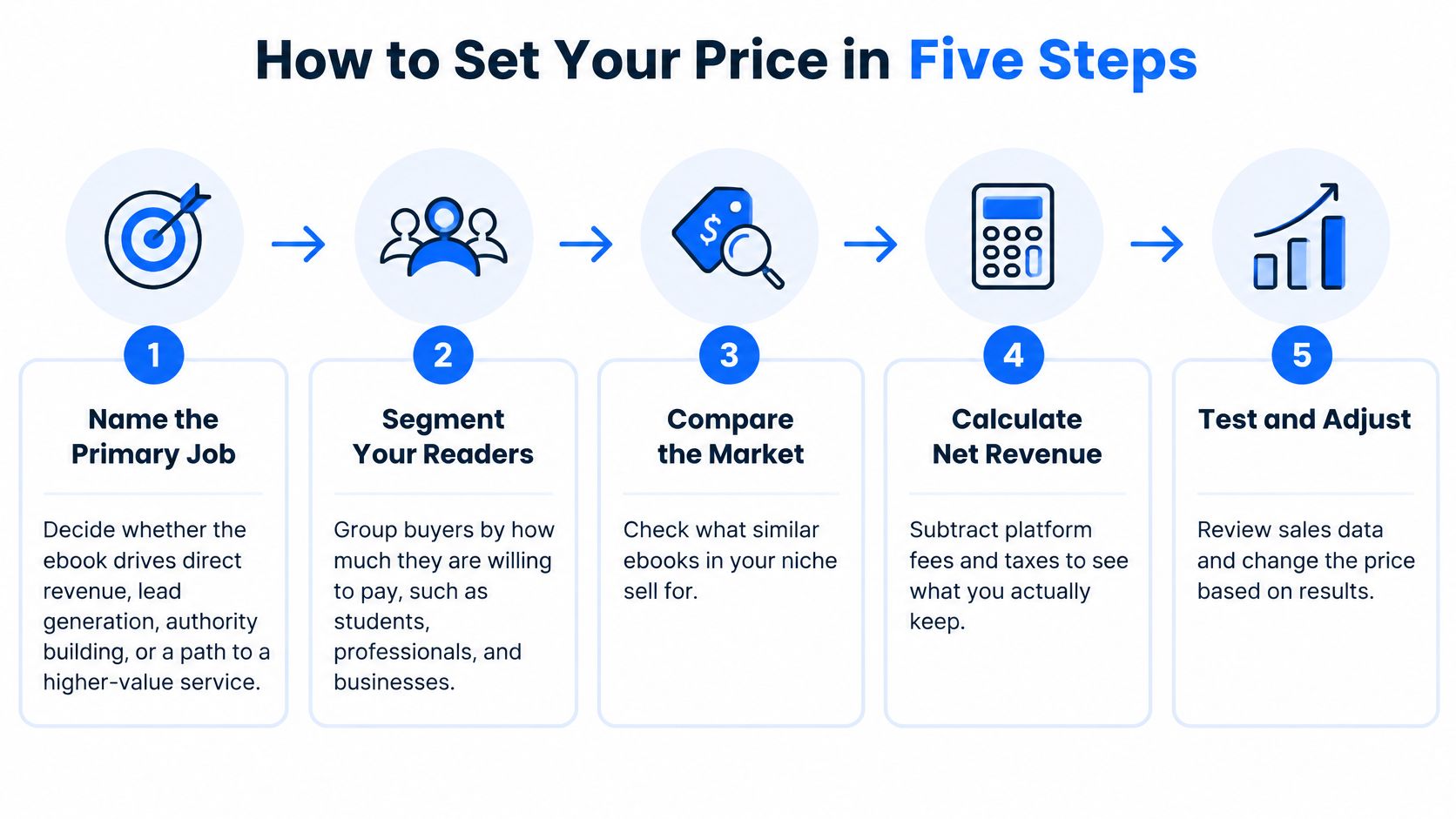
Name the ebook's primary job. Choose direct revenue, lead generation, authority building, or qualification for a higher-value service. A free resource can succeed at attracting suitable prospects while failing completely as a standalone revenue product.
Segment readers by urgency and budget. A manager facing an immediate operational problem has a different buying decision from a hobbyist browsing for ideas. Write down who pays, what they need to accomplish, and what happens if they leave the problem unresolved.
Benchmark genuinely comparable offers. Record topic, depth, publication recency, author credibility, included assets, and any print equivalent in a spreadsheet. Exclude famous-author outliers and unrelated bargain titles, because neither gives you a useful starting comparison.
Set a reference price and calculate its contribution. Choose a position within your product category, then select a lower and higher test price that both pass your cost check. If neither leaves enough contribution, revise the offer, distribution method, or acquisition plan before asking traffic to solve the problem.
Run the test and keep the economically stronger offer. Use comparable traffic and launch conditions, then assess retained contribution per visitor alongside buyer satisfaction. Follow the test controls below, rather than treating a busy launch as proof that a price works.
Apply the process to separate products
Say a coach creates a hiring checklist and a detailed recruitment handbook. The checklist helps a buyer prepare for an immediate task; the handbook supports a broader hiring process. They shouldn't receive the same price just because the same person wrote them.
For the checklist, the coach might prioritize an accessible entry purchase and track whether buyers later request relevant help. The handbook needs its own commercial case, including the value of its examples, decision frameworks, and reusable resources.
Give each product its own job, cost calculation, and price test. Don't make the handbook subsidize an entry product accidentally.
Before testing either offer, write a short decision note: intended buyer, promised outcome, proposed price, expected contribution, and success measure. This prevents you from changing the definition of success after seeing disappointing results.
Repeat the process when you materially change the audience, product, or channel. An expanded manual sold to employers is a different offer from a personal-use guide, even if some chapters overlap.
Testing Prices Without Fooling Yourself
Academic work covering Japan, the United States, and the United Kingdom found ebook demand elasticity below 1, while an analysis of 681 Kindle titles estimated overall elasticity between 0.70 and 0.87, as summarized in this University of Tsukuba academic abstract. In plain language, the estimated decline in demand was proportionally smaller than the price increase.
The analysis also found greater sensitivity among higher-ranked books and lower sensitivity in practical categories such as qualifications, health, and parenting. That supports testing a stronger price for specialized help, not assuming that cheaper always produces better economics.
Separate the price effect from the launch effect
Observed sales aren't proof of causation. Reviews, ranking, reputation, and promotions can affect both the price an author chooses and the sales that follow.
Keep the sales-page copy, included files, refund terms, and traffic source stable during a price test. Don't compare an enthusiastic subscriber launch with a later period of unfamiliar search visitors and attribute the difference to price.
| Metric | What it tells you | Warning sign |
|---|---|---|
| Conversion rate | Share of visitors who buy at each price | Sharp drop at the higher price with the same traffic source |
| Revenue per visitor | Combined effect of price and conversion | Higher price appears stronger, but refunds erase the gain |
| Refund rate | Whether buyers feel the content matches the price | Refunds rise after a price increase |
| Email sign-ups or later purchases | Downstream value of each buyer | Cheap price brings buyers who never return |
| Sales by country | Whether the offer works across markets | A market weakens while others hold steady |
Calculate revenue per visitor using retained revenue, then calculate contribution per visitor after sale-related costs. That second measure prevents a high-revenue offer with expensive support or acquisition from appearing more profitable than it is.
Decide before results arrive
Choose the competing prices, traffic source, stopping rule, and decision measure in advance. Keep the test running long enough to include ordinary buying behavior and allow refund requests to emerge.
If purchases are sparse, call the result inconclusive. Don't declare a winner from an isolated order, and don't keep checking until a temporary fluctuation supports your preferred price.
For an entry product, include a defined follow-up window when evaluating later purchases. For a standalone handbook, prioritize retained contribution and fulfillment quality. The right decision rule follows the product's job, not whichever metric happens to look strongest.
Bundles and Tiers Instead of Repeated Discounts
Repeatedly marking down the same file teaches buyers that waiting may be worthwhile. It also leaves an important question unanswered: would someone pay more for help applying the material?
Test a base ebook against a meaningfully different bundle. Keep the reading-only option useful, and make the premium option reduce implementation work.
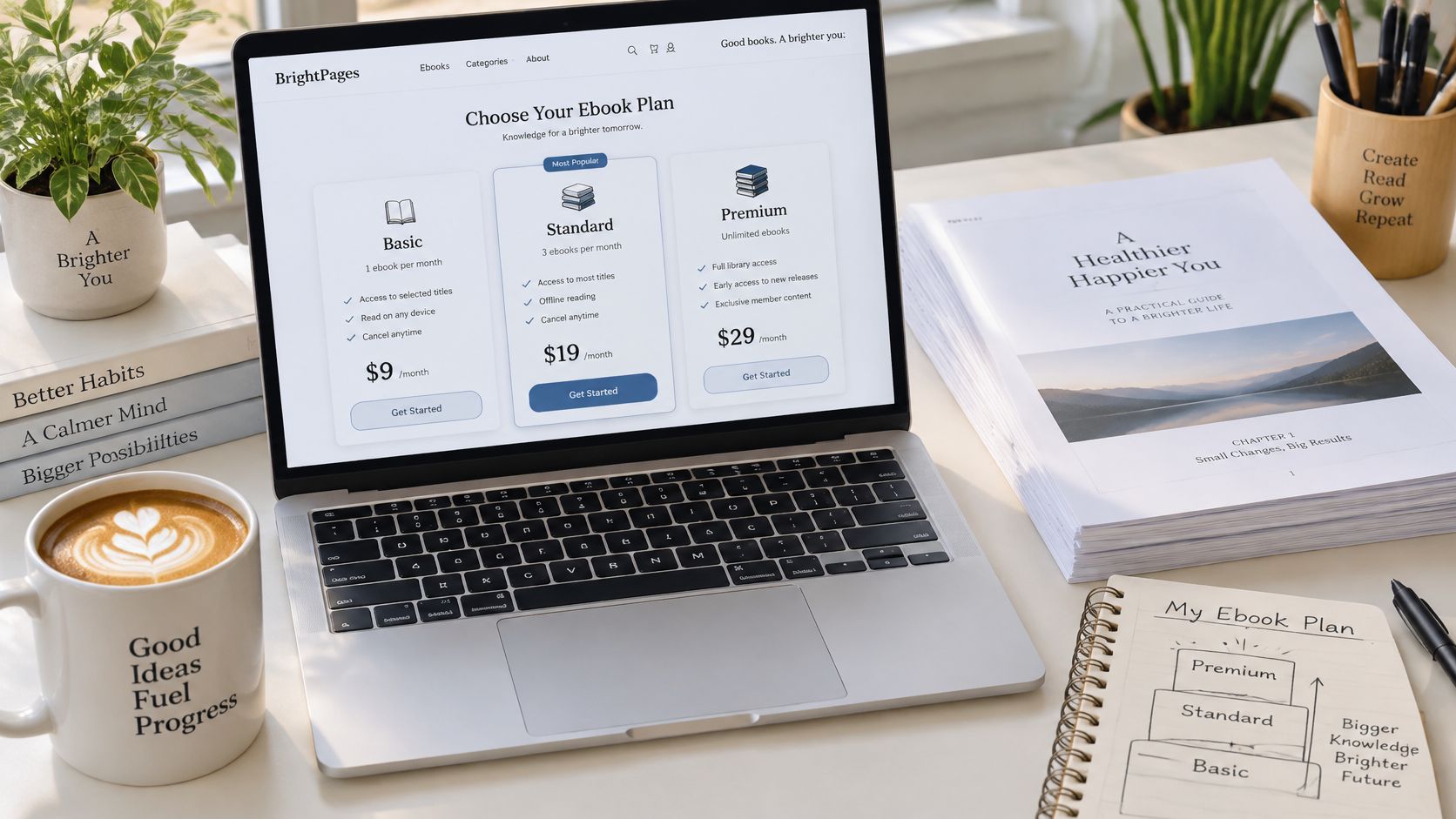
Say a practical guide explains how to build a client onboarding process. Its premium edition could add editable welcome emails, a task checklist, a worked project example, and a clearly defined update commitment. Those additions help buyers complete the task rather than merely giving them more to read.
German consumer figures offer useful context, but not a guaranteed pricing formula: the average price paid for a consumer ebook rose 7.6%, from €6.63 to €7.13, in the first half of 2025, according to Börsenverein's ebook market report. That shows higher average spending per ebook in that market, not that adding templates automatically raises willingness to pay.
Charge for useful implementation
Consumer research discussed in the digital and print book pricing paper identifies perceived fairness and the print alternative as relevant to purchase decisions. Your premium needs an understandable reason, not an inflated comparison price.
Avoid these mistakes:
- Pricing by word count: Extra explanation isn't necessarily extra utility.
- Copying fiction prices: A specialist workflow needs comparison with relevant alternatives.
- Assuming low means valuable: An inexpensive file still disappoints if buyers can't use it.
A premium bundle should remove work from the buyer's desk, not add files to their downloads folder.
Compare conversion and contribution per visitor for the base offer and bundle. Include the cost of maintaining templates, delivering updates, or providing calls, because those promises create ongoing obligations.
Confirm Your Price Before You Launch
Check international tax treatment before publishing your prices. The European and International Booksellers Federation's July 2025 comparison shows ebook VAT ranging from 0% in some markets to reduced or standard rates elsewhere, depending on country and format.
Check the local buying experience alongside the tax calculation.
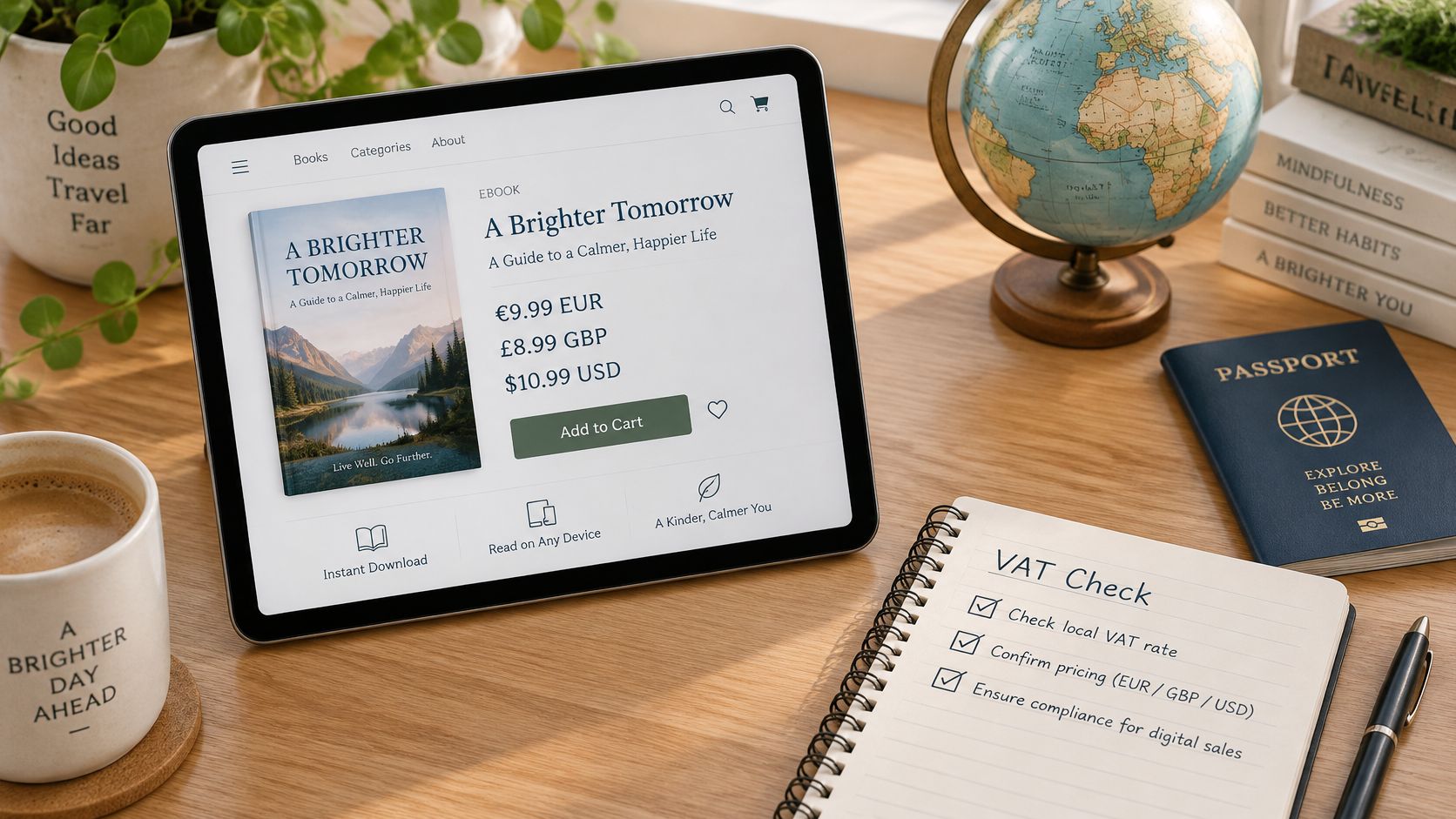
For each intended market, record the currency, displayed price, tax treatment, applicable fees, and expected contribution. Decide whether to absorb tax within the displayed price or add it where appropriate, and check whether local rounding makes the offer understandable.
A direct bundle and a retailer edition can serve different buyers, but make the distinction explicit. Check current retailer royalty eligibility before submitting any price change, rather than assuming your existing payout structure will continue.
Check the complete purchase
Keep the product private while checking its content and buying steps. Our guide to selling ebooks online can help you organize the wider launch workflow.
- Offer accuracy: Confirm that the sales page matches the files and resources delivered.
- Checkout clarity: Verify currency, displayed tax, payment details, and buyer confirmation.
- Access and fulfillment: Test downloads and buyer access using the actual delivery flow.
- Customer obligations: Publish clear contracts and refund terms, and check taxes, accessibility, and fulfillment.
You remain responsible for the products you publish and sell, including those customer obligations. Software can support delivery, but it doesn't replace reviewing what you've promised.
Use the buying-flow walkthrough as another prompt to inspect the path from offer to access.
Today, record your chosen price for each market, expected contribution, test decision rule, and review date in your project notes. Publish only when the purchase works and the economics are credible. Your first price is a testable decision, not a permanent verdict.
Genesize brings AI-assisted ebook creation, a hosted storefront, Stripe checkout, delivery, and sales analytics into one workspace so you can build the offer and inspect its results. Visit Genesize to start with the 14-day trial, which includes 400 total AI credits and up to three saved product projects, and prepare your ebook and buying steps before launch.