Best Affiliate Programs 2026: Zero-Cost Picks That Pay
Best affiliate programs 2026 that cost nothing to join, compared by payout, cookie window and fit, plus where to promote them for free.

By June 1998, Amazon reported that enrollment in its Associates Program had exceeded 60,000 members, after doubling twice in under a year. That early growth still explains what makes a program worth joining. People signed up because enrollment was simple, links were trackable, and the rules were clear enough to act on.
That's the right test for the Best Affiliate Programs 2026 offers on your shortlist. Don't rank by the biggest percentage on the sales page. Rank by whether you can get approved, promote the product on a channel you already use, disclose the relationship properly, and reach the payout threshold before your motivation runs out. A program you can keep using for a year will usually beat a higher paying program you have to drop after one post.
Free-to-Join Affiliate Programs Compared
| Program type | Cost to join | How it pays | Best fit |
|---|---|---|---|
| Genesize affiliate program | Free, no paid plan required | 40% recurring on eligible subscription payments | Creators and educators who already talk about ebooks or courses |
| Amazon Associates (marketplace) | Free | Percentage of qualifying sales, rates set by product category | Product reviewers and gift guide publishers |
| Digital-product platform referral | Free to join, check terms | Recurring or per-sale percentage stated on the program page | Course and ebook sellers |
| Typical SaaS program | Free in most cases | Recurring percentage or flat fee stated in the partner terms | Newsletter writers and B2B content sites |
| Physical-product retailer program | Free | Percentage per sale, often with a short cookie window | Blog reviews and seasonal recommendations |
One point needs to be clear before you compare anything else. Genesize does not offer a permanent free plan, so the free part covers only joining our affiliate program, not using the software itself. Joining doesn't require a paid plan either, which matters if you want to test a referral link before you commit to building a product.
Read the table by matching your existing audience to the Best fit column first, then look at how each row pays. Shortlist two rows that fit content you're already making, and ignore the rest for now.
Why Audience Fit Comes Before the Rate
Advertisers are putting serious money behind this channel. According to Wix's summary of affiliate marketing statistics, the worldwide market was estimated at approximately $18.4 billion in 2025, with projections reaching $20.07 billion in 2026, while U.S. advertiser spending was estimated at $12.42 billion in 2025. A large market doesn't make any single program right for you. It means merchants can afford to be selective, and you should be selective in return.
A gardening newsletter won't convert on B2B software just because the commission looks generous. A teacher who already shares lesson resources has a natural path into ebook and course tools, templates, and classroom products. If you're still deciding what to sell yourself, browsing practical digital product ideas for creators will show you which affiliate offers sit naturally beside your own products instead of competing with them.
Practical rule: Pick programs your audience would thank you for recommending even if you earned nothing. Those are the recommendations that survive a slow first month.
What Each Row Really Demands From You
Marketplace programs convert on trust and convenience, but rates by category can be thin and windows can be short, so you need volume. SaaS and digital product programs pay fewer, larger commissions, but you have to explain a tool well enough that someone starts a subscription. Physical retail sits in between, and it rewards seasonal, gift, and comparison content that you refresh when products change.
Unknown terms in any row are a reason to pause, not guess. Before you apply, open the program page and confirm the rate, the products it applies to, and whether renewals count. Write down the answers next to each row so you're comparing facts, not impressions from a landing page.
Shortlist two rows now, before you read on. Every check that follows is faster and more honest when you're testing two named programs instead of daydreaming about ten.
Screening Programs and Their Disclosure Rules
Run these six checks in order on each shortlisted program. Approval and traffic rules come first because a failure there ends the conversation, no matter how good the payout looks.
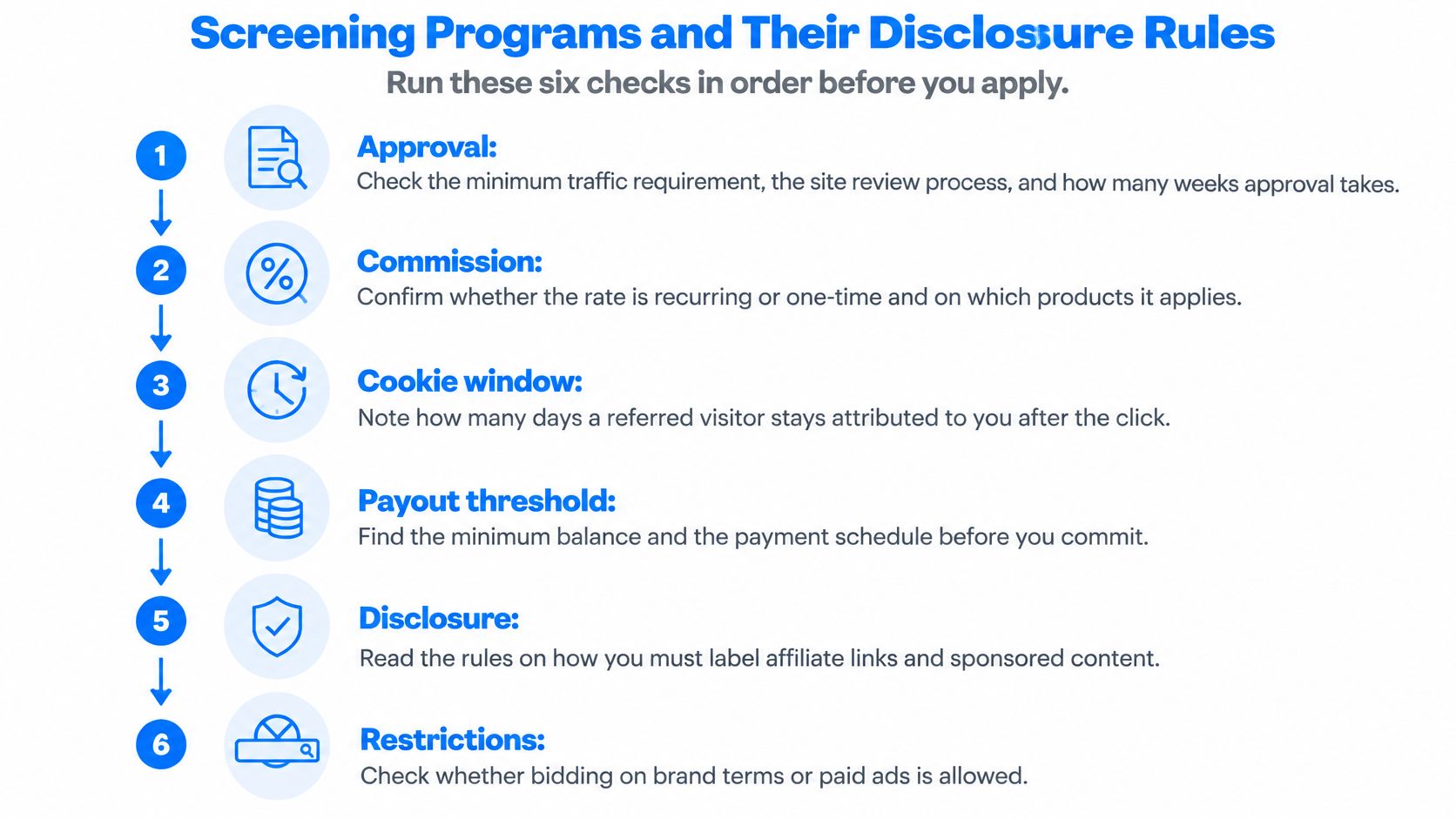
- Approval: Check the minimum traffic or audience requirement, whether staff review your site by hand, and how long a decision takes. Weeks of silence with no stated reason is a red flag, because you'll get the same treatment when a payment goes missing.
- Cookie or attribution window: Note how many days a click can still credit you with a later sale. Short windows punish considered purchases like courses and software, where people read, compare, and buy the following week.
- Asset library: Look for banners, swipe copy, and approved product claims you're allowed to repeat. If you must explain a multi-feature platform with no approved language, you'll either write vague posts or risk saying something the merchant won't stand behind.
- Payout threshold and schedule: Find the minimum balance and the payment date. A threshold higher than a realistic first six months of earnings means your early work sits locked in someone else's account.
- Traffic source rules: Search the terms for bans on email, paid ads, coupon sites, brand bidding, or incentivized traffic. One banned channel can disqualify your whole plan.
- Support and payment coverage: Look for a named affiliate contact or a ticket system with a stated response time, plus the countries and currencies the program pays. A contact form with no response time and one payout method that doesn't reach your country is not a program, it's a dead end.
| Criterion | What to check | Red flag |
|---|---|---|
| Approval | Minimum audience, site review and approval wait | Approval takes weeks with no stated reason |
| Cookie window | How long a click can credit a later sale | Very short window for considered purchases |
| Asset library | Banners, copy and approved product claims | No approved claims for a product you must explain |
| Payout threshold and schedule | Minimum balance and payment date | Threshold higher than a realistic first six months of earnings |
| Traffic-source rules | Bans on email, paid ads, coupon or incentivized traffic | Ban on the one channel you already use |
| Support | Named affiliate contact or ticket system | Contact form only, with no response time stated |
| Payment coverage | Countries and currencies paid | Single payout method with no option for your country |
The Disclosure Layer You Apply to Every Post
Screening doesn't end at approval. Recent compliance coverage on AI endorsement rules makes the point that AI-generated reviews, cloned voices, and synthetic promotional avatars require clear disclosure, while endorsements must still reflect an authentic experience. That's industry commentary rather than primary government guidance, so check the rules against your applicable regulator before you publish.
In practice, put a plain affiliate note beside each link and inside each video description, not buried at the bottom of a page. Say only what you've used yourself or can substantiate from the merchant's approved claims. When a program updates its terms, recheck your live posts, because a claim that was fine in March can be prohibited by June.
Say a reviewer plans to feature a tool in a weekly newsletter, reads the terms first, and finds email promotion banned. She drops the program that afternoon instead of building a month of content she can't send. That's the checklist working as intended.
A red flag on approval or traffic rules outweighs a higher commission every time. A lower paying program with clear policies and low compliance risk will usually out-earn a lucrative offer that ends in takedowns or clawbacks.
Recurring Versus One-Time Payouts in Numbers
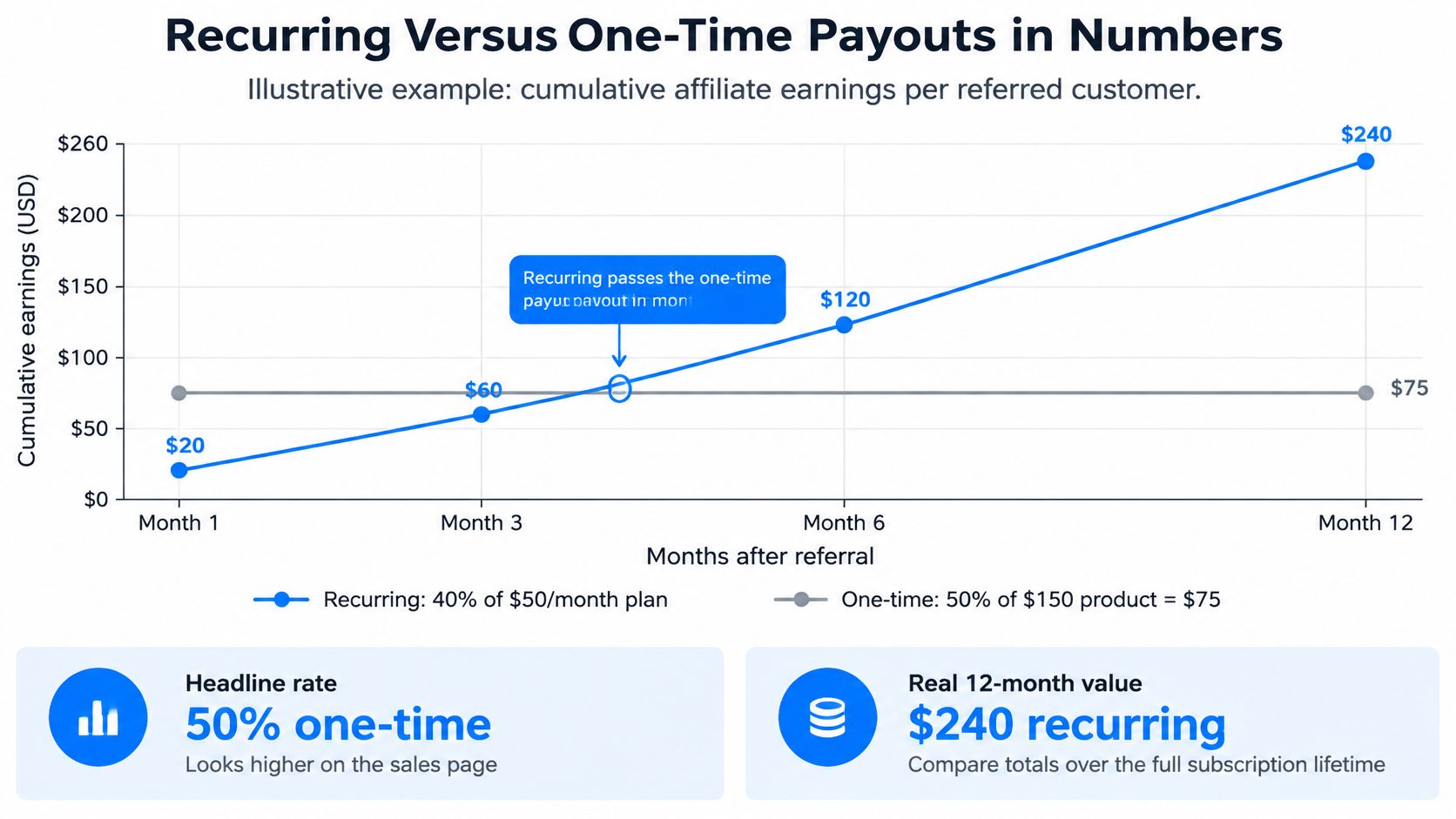
A $30 monthly plan at 40% pays $12 per paying referral each month. That one sentence explains recurring commissions better than any headline percentage, so start every comparison by turning the rate into dollars per customer.
Our affiliate program pays 40% recurring commission on eligible subscription payments from referred customers. The example below is hypothetical and uses that rate against an illustrative $30 plan. Check the actual rate and eligibility terms on the program page before you rely on any figure.
The chart below shows how a recurring payout catches and passes a one-time payout when a customer stays subscribed.
| Paying referrals kept | Monthly payout |
|---|---|
| 5 referrals | $60 |
| 10 referrals | $120 |
| 25 referrals | $300 |
If those referrals stay for twelve months, the yearly totals are $720, $1,440, and $3,600. Notice what drives the number. It isn't the rate alone, it's the rate multiplied by how many customers you refer and how long they keep paying.
Where the Arithmetic Breaks Down
Retention is the weak point in every recurring projection. A referral who cancels after month two pays you two months, not twelve, so a table built on perfect retention flatters you. I'd model a pessimistic version too, where a chunk of referrals leave early, and see whether the program still justifies your time.
Refunds cut the other way. Programs can reverse a payout when a customer gets money back, and the terms define how reversals are handled and how long a commission stays provisional. Read that clause before you spend earnings that haven't cleared.
Compare that with a one-time deal. A 30% commission on a $200 course pays $60 once, and earning the next $60 requires a brand new sale. That's fine for a launch or a seasonal push, and it pairs well with the approach in this guide to selling digital products in 2026, but it resets to zero every month.
The short video below walks through the same comparison if you'd rather hear the numbers than read them.
Choose recurring programs when your audience keeps subscriptions as part of their work, like teachers, coaches, and small teams running tools month after month. Choose one-time programs when your strength is a single launch, a gift guide, or a seasonal roundup. Either way, compare twelve month value per customer, not the percentage in the headline.
Where to Promote Without Spending Money
Start with the uncomfortable number. In eMarketer's 2026 affiliate marketing FAQ, 69% of U.S. publishers worry that Google algorithm changes and AI Overviews are reducing traffic and affiliate revenue, while creators' share of Awin revenue rose from 15.9% to 19.5% year over year. Search traffic is getting less dependable, and creator led distribution is taking a bigger share. Your channel plan should reflect both facts.
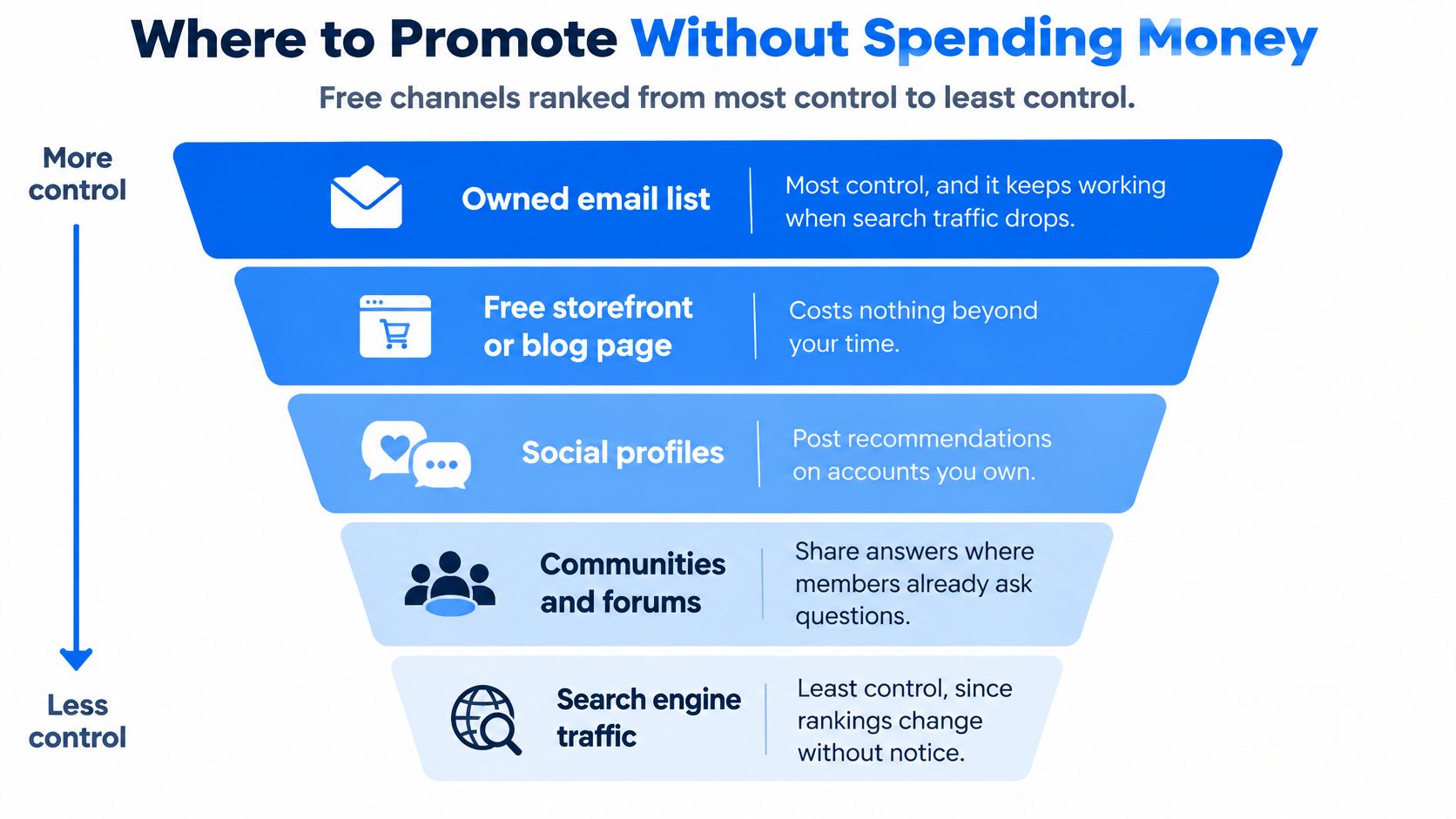
The funnel graphic below ranks free channels by how much control you keep over them.
Channels Ranked by Control
An owned email list gives you the most control. You decide when to send, nobody can downrank your inbox placement overnight, and the list keeps working when search traffic drops. It's slow to build, but every subscriber is an asset you carry between programs.
A free storefront or blog page costs nothing beyond your time and gives your recommendations a permanent home you can link from everywhere else. Short-form video works when you put the link in the description and say the disclosure out loud, and social posts work best when you've used the product and can show it. Communities and forums help only where their rules allow links, so answer questions first and link second, or don't link at all.
Marketplaces bring their own buyers, which is tempting when you're starting from zero. The trade-off is attention, because your recommendation sits beside every competitor and the platform owns the customer relationship. Use marketplaces for discovery if you like, but move people toward your list.
A Funnel You Can Build This Week
- Free lead magnet: Publish a one-page checklist that solves one small problem for your audience.
- Short tutorial: Record or write a walkthrough that uses the checklist, so readers see the method work.
- Three email sequence: Send the checklist, then a tip that deepens it, then one relevant affiliate recommendation in the third email.
- One recommendation only: A single disclosed link in that final email keeps the message clear and easy to track.
Say a teacher writes a free one-page lesson planning guide and emails it to 300 subscribers over three weeks. The first two emails teach, and the final email recommends one software tool she uses to turn her lessons into a paid resource. That structure works for course creators too, and this walkthrough on how to launch an online course covers the product side of the same funnel.
Diversify across owned email, your own product sales, and affiliate income. Any single source can drop without warning, and three modest streams survive shocks that kill one big one.
If you have subscribers, start with email. If you have followers but no list, start with short video and use it to build the list. If you have neither, publish the lead magnet and one tutorial, and let everything else wait.
Pick One Program and Test It for 30 Days
Testing beats comparing. Give yourself thirty days, one channel, and a spreadsheet, and you'll learn more than another month of reading roundups will teach you.
- Shortlist two programs from the comparison table that pass every screening check. Two is enough to compare without splitting your effort into nothing.
- Read the approval, traffic, and payout terms and save a copy of the page. Terms change, and your saved copy proves what you agreed to when you published.
- Pick one channel you already use, such as your email list, a blog page, or short video. A new channel plus a new program gives you two unknowns and no useful result.
- Publish one disclosed recommendation per week for four weeks, with the affiliate note beside each link. Consistency matters more than volume at this stage.
- Track clicks, signups, and payouts for each program in a simple spreadsheet. Note the hours you spent, because earnings per hour is the number that decides the winner.
- After 30 days, keep the program that earned the most per hour spent and passed every compliance check. Drop the other one without sentiment.
Setting an Honest Expectation
Small audiences often see few or no sales in the first month. That isn't failure, it's arithmetic, and it's why you should judge the test on clicks and signups before revenue. Steady clicks with no sales point to a weak offer or a short cookie window. No clicks at all point to placement or audience fit, which you can fix.
Genesize belongs on the candidate list if your readers sell ebooks or courses, since joining is free and the commission is 40% recurring on eligible subscriptions. Read the terms before you apply, exactly as you would for any other program on your shortlist. I'd give it the same thirty day test and let the spreadsheet decide.
The best program is the one that fits your audience and survives the rules, not the one with the biggest headline rate.
If you're building an audience around ebooks or courses, Genesize gives you one workspace to create the product, sell it from a hosted storefront, and earn 40% recurring commission when you refer other creators to do the same. Join the affiliate program free, run the thirty day test described above, and keep it only if your own numbers say it earns its place.